In-Line Viscometer Description
1-6 P/N M/97-520
Correlation with Other Measurements
Typically, there is a difference between laboratory and process viscosity
measurements. Laboratory measurements, for a given fluid, are usually
higher than process measurements.
Viscosity measurements are unique among common types of fluid
measurement in that, for most fluids, numerical values that are generated
are dependent upon flow conditions in the fluid being measured (shear rate
or velocity gradient). Other factors such as temperature change,
turbulence, and pressure among the most prominent, also affect the
readings.
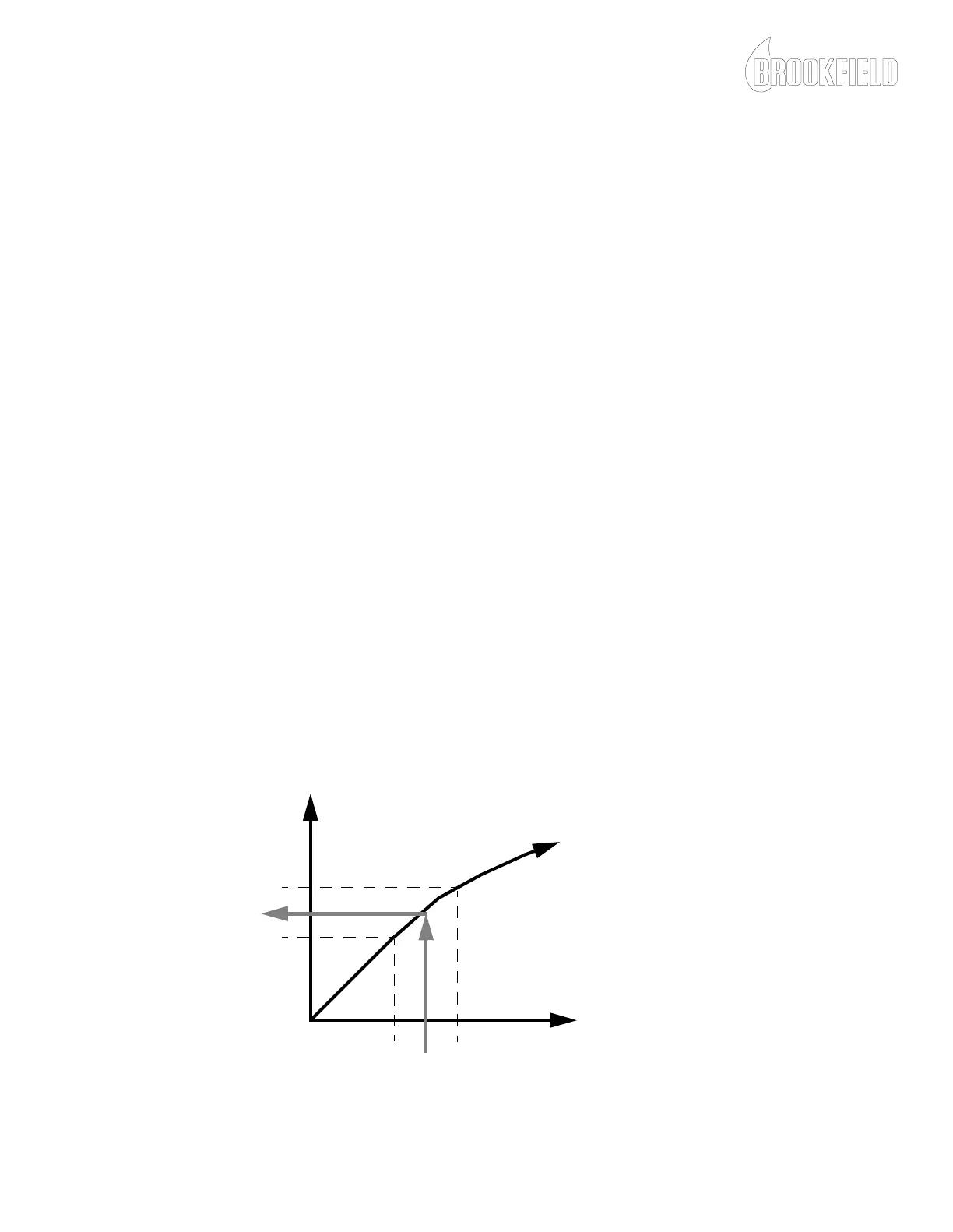
Frequently it may become necessary to correlate readings provided by
your on-line viscometer to those factors that influence viscosity obtained
by other methods. The correlation consists of holding the viscosity
dependent factors constant, as mentioned above, and plotting the on-line
viscosity value against the other reading as shown in Figure 1-4. A
successful empirical correlation will assure the process operator that an on-
line reading can be matched to a viscosity value derived by the other
method. The correlation of these readings may be instrumental in
educating process operators how the process stream relates to bench-top
derived viscosity measurements.
Many factors beyond those noted above, which are more difficult to control
in an on-line situation than in a laboratory environment, can potentially
affect your correlation. Refer to Appendix A and contact Brookfield
Engineering Laboratories, Inc. for assistance in generating an empirical
correlation.
Figure 1-4: In-Line Viscometer Correlation with Other Measurement Techniques
C
O
R
R
E
L
A
T
I
O
N
ACCEPTABLE LIMIT
ACCEPTABLE LIMIT
ONLINE VISCOMETER READING (cP)
AT PROCESS TEMPERATURE
LAB/QC VISCOMETER READING (cP)
AT STANDARD TEMPERATURE



 To Next Page