TT100 In-Line Viscometer Installation, Operation, Maintenance and Service Instructions
P/N M/97-520 1-9
Cleaning
To ensure proper viscometer operation, it is important to properly clean or
flush the viscometer at regularly scheduled intervals. Solids can build up
on the opposing cylinder surfaces and interfere with the angular movement
of the stator and torsion element and their movement in relation to the stop
posts which protrude through the stator. Additionally, solids can build up at
the mechanical seal which may affect its ability to maintain leak-free
operation.
The user must establish cleaning procedures and cleaning fluids.
Clean-In-Place (CIP) is strongly recommended as the cleaning procedure
of choice. In addition to CIP, the user may choose the flushing option in
order to direct cleaning fluid to the internal components to enhance the
cleaning process. The third choice for cleaning is to manually clean the
internal components. This is not a recommended practice due to the
damage that can be caused on the torsion element when exposed to this
manual cleaning.
The clean-in-place procedure can be accomplished with high flow rate
cleaning fluid or steam.
NOTE: The cleaning fluid must be compatible with the seal. Steam
Temperature should not be higher than the temperature rating of the
viscometer.
In some instances, the instrument installation can be plumbed with 2 three-
way valves with the cleaning fluid introduced and drained through the side
ports of these valves.
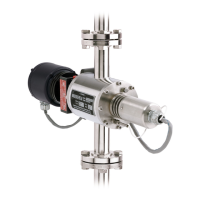
The flushing option, available in the TT100, is offered in either or both
endcaps. When in use, the cleaning fluid is introduced towards the internal
components through directional spray nozzles. This cleaning procedure
should be accomplished with the measuring chamber void of any process
fluid and the cleaning fluid at a pressure of approximately 30-40 psi and a
flow rate of 3-10 gpm.
Refer to Section 5 - Maintenance for clean-in-place or flushing
procedures.



 To Next Page