slots in these three members. The top of the cylin-
der contacts the top of the slot in the bed. The bot-
tom of the piston contacts the bottom of slots in the
auxiliary cross members.
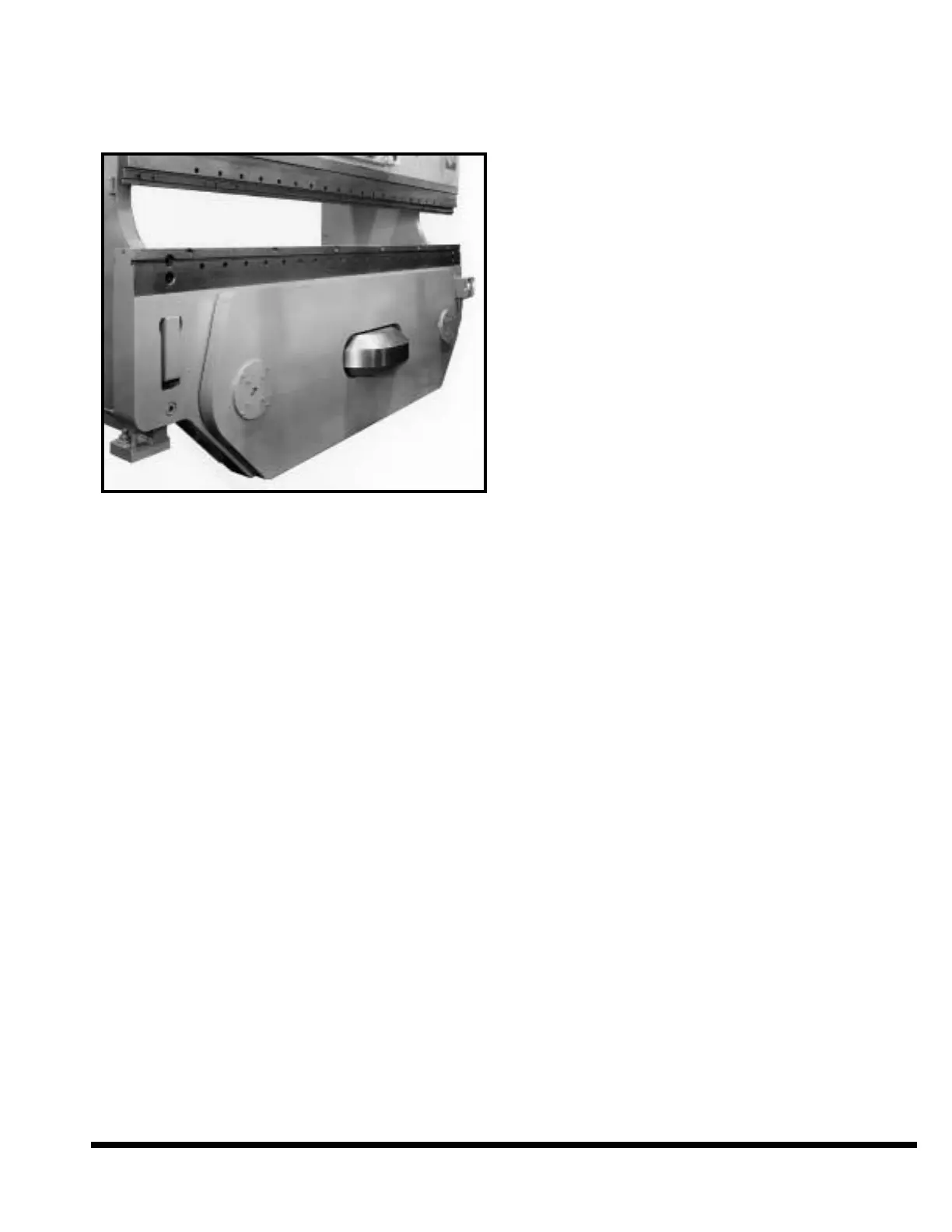
FIGURE 8-5 – Auto Crown
The force developed by Auto Crown is approximate-
ly twice as large as the forming load. This force
pushes up on the bed causing the bed to deflect up
an amount equal to the deflection of the ram. The
result is that the bed and ram remain parallel and
the upper die penetration is uniform along the bend
length. Auto Crown is available on 400FM x 10’ and
longer, 500FM and 600FM x 12’ and longer, and
750FM and 1000FM x 14’ and longer. 10’ and 12’
machines have one Auto Crown cylinder. Longer
machines have two Auto Crown cylinders.
TANDEM MODE
Tandem operation is the simultaneous operation
of two press brakes placed side-by-side. When
operating in this fashion, parts can be formed that
are as long as the total length of the two
machines. The two machines may be operated
either independently or in tandem mode. When
the machines are operated independently, they
operate as two standard FM Press Brakes. The
only limitation in independent operation is the
physical proximity of the two machines. When the
machines are operated in tandem, the right hand
machine becomes the master and all program-
ming and setup takes place on the master control.
The left hand machine becomes the slave
machine. The slave machine will duplicate all
actions of the master, both ram motions and gage
motions.
When using Tandem operation, the bending load is
typically distributed evenly and centered about the
tandem centerline. Also the beds and rams of the
two machines are symmetrical about the tandem
centerline. When the bend length spans the full
length of both machines, each machine is typically
close to being center loaded. If the overall bend
length is shorter, each machine is in an off-center
loaded condition. If the bend length is too short,
where there is no loading at the outer cylinders, the
rams will go out-of-level. These bends should only
be done on one machine operated independently.
The following information describes the controls
and procedures required to operate tandem FM
Press Brakes. It only covers items that are unique
to tandem operation. For a description of standard
operation of the FM Control, refer to SECTIONS 6
and 7.
TANDEM MACHINE CONTROLS
A single selector switch is provided on the master
machine’s electrical enclosure. This switch selects
whether the machines will operate independently
or in tandem. In the “SINGLE” position, the two
machines will operate independently; in the
“DUAL” position, the slave machine will duplicate
the actions of the master machine. Whenever the
switch position is changed, both machines will
display the MAIN MENU on the control screen.
When in Tandem Mode, the only controls that are
active on the slave machine are the RAM UP but-
ton, EMERGENCY STOP button, OPERATOR con-
trol switch and the MAIN DRIVE START and STOP
buttons. All palmbutton and footswitch stations
on the slave control will be inactive, all front panel
selection (forming speeds, stroke stops, etc.) will
be inactive.
TANDEM PROGRAMMING
Two additional program values appear on the
PROGRAM DATA screen when operating in Tan-
dem Mode. These are “SLV OFFSET” (slave offset)
and “SLV TILT” (slave tilt).
SLAVE OFFSET
In Tandem Mode, the programmed ram values are
controlled by the inboard linear transducer of the
master machine (left transducer of the right hand
machine). The “SLV OFFSET” value is applied at
the inboard transducer of the slave machine and is
used to match the inboard end of the upper die on
the slave machine to the inboard end of the upper
die on the master machine.
The slave offset is programmed between -1.000 and
+1.000 inches (-25.40 to +25.40mm). When the off-
8-3


 To Next Page