SERVICEAND TROUBLESHOOTING
A WARNING: THE ABILITY TO
PROPERLY PERFORM SERVICE
ON THIS EQUIPMENT REQUIRES
CERTAIN EXPERTISE,
MECHANICAL SKILLS, TOOLS
AND TEST EQUIPMENT. IF YOU
DO NOT POSSESS THESE, DO
NOT ATTEMPT TO PERFORM ANY
MAINTENANCE ON THIS
EQUIPMENT OTHER THAN THOSE
PROCEDURES RECOMMENDED
IN THE USER'S MANUAL.
A FAILURE TO FOLLOW THIS
WARNING COULD RESULT IN
POSSIBLE DAMAGE TO THE
EQUIPMENT, SERIOUS
PERSONAL INJURY, OR DEATH.
The HVAC industry, like the auto
industry, is faced with increasing
government imposed efficiency
regulations. New and more
sophisticated mechanical means for
achieving higher efficiencies have
been engineered. Gone are the days
when all a person needed to work on
an auto was just a wrench and
screwdriver. The same is true with
heating and cooling equipment. The
use of test equipment is now more
critical than ever.
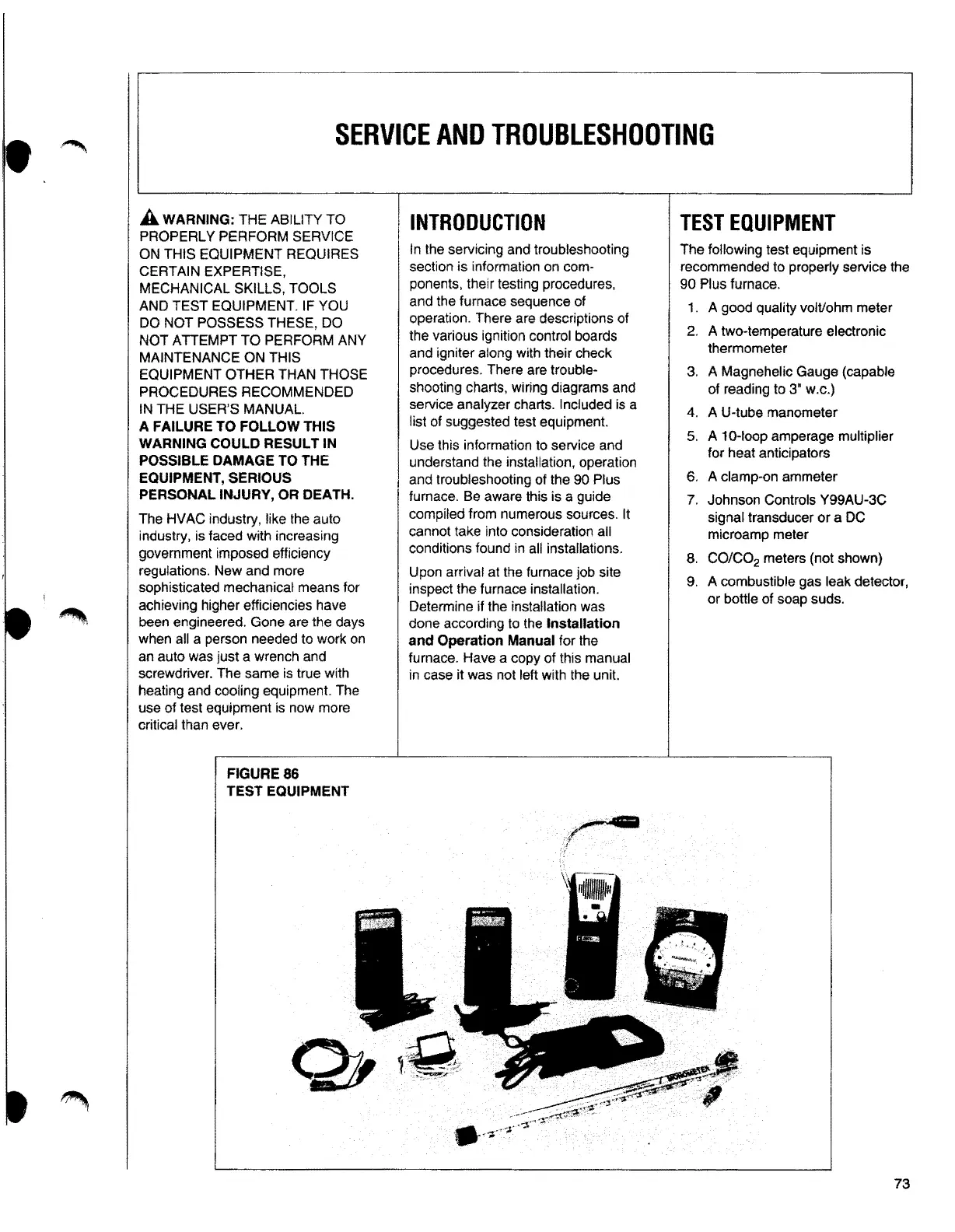
FIGURES&
TEST EQUIPMENT
INTRODUCTION
In the servicing and troubleshooting
section is information on com-
ponents, their testing procedures,
and the furnace sequence of
operation. There are descriptions of
the various ignition control boards
and igniter along with their check
procedures. There are trouble-
shooting charts, wiring diagrams and
service analyzer charts. Included is a
list of suggested test equipment.
Use this information to service and
understand the installation, operation
and troubleshooting of the 90 Plus
furnace. Be aware this is a guide
compiled from numerous sources. It
cannot take into consideration all
conditions found in all installations.
Upon arrival at the furnace job site
inspect the furnace installation.
Determine if the installation was
done according to the
Installation
and Operation Manual
for the
furnace. Have a copy of this manual
in case it was not left with the unit.
TEST EQUIPMENT
The following test equipment is
recommended to property service the
90 Plus furnace.
1.
A good quality volt/ohm meter
2.
A two-temperature electronic
thermometer
3.
A Magnehelic Gauge (capable
of reading to 3" w.c.)
4. A U-tube manometer
5.
A 10-loop amperage multiplier
for heat anticipators
6.
A clamp-on ammeter
7. Johnson Controls
Y99AU-3C
signal transducer or a DC
microamp meter
8. CO/CO
2
meters (not shown)
9. A combustible gas leak detector,
or bottle of soap suds.
QJ,
73


 To Next Page