What is characteristic for this sensor is the fact that it has polarity, which is crucial when connecting
it to EMU. Inversely connecting it will prevent the synchronization of ignition. Signal from such
sensor, especially with low speeds, where its amplitude reaches several hundred millivolts, is very
sensitive to interference. For this reason it must always be connected with a shielded cable. It
should also be emphasized that the screen connected to the mass can be only on one side of the
cable.
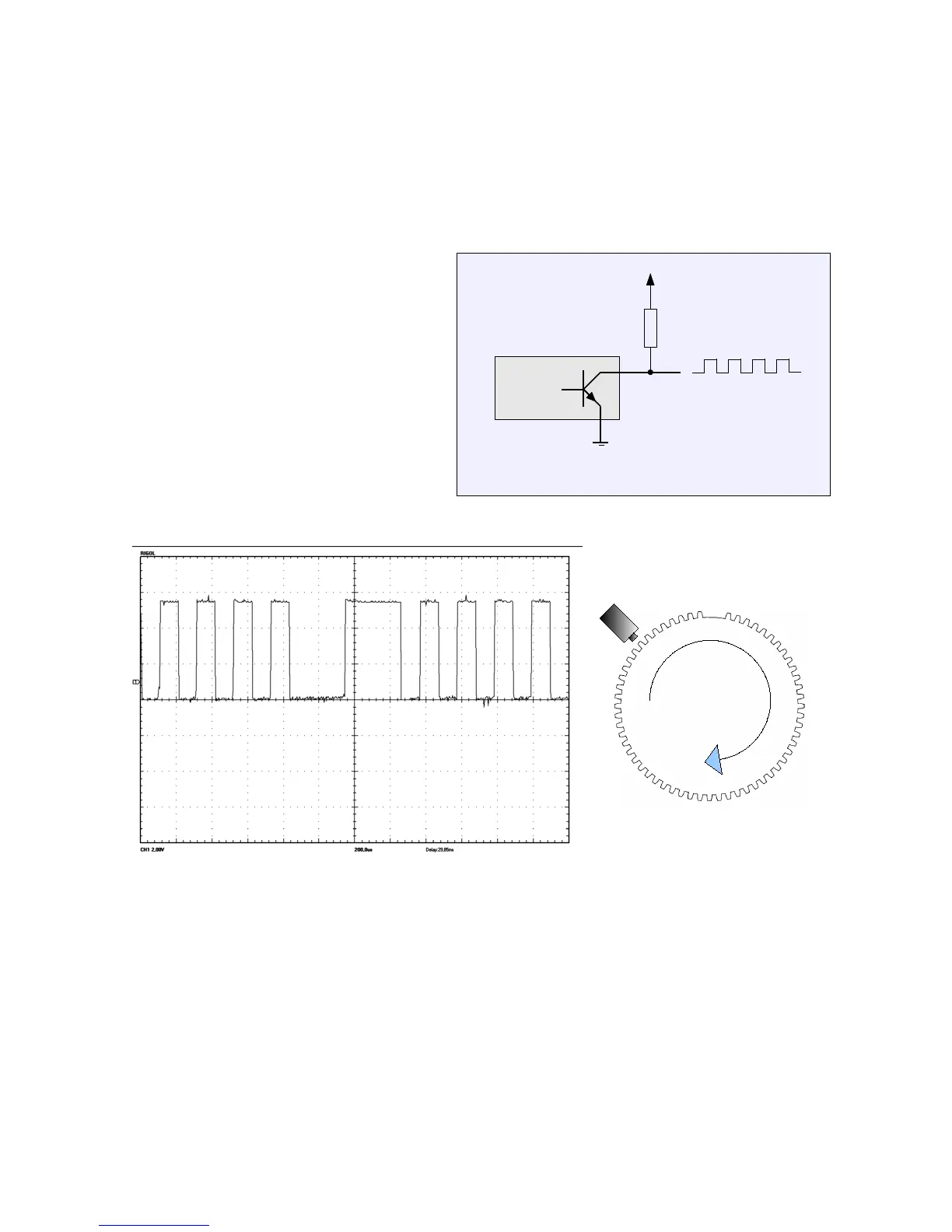
A different kind of sensor of engine speed is
a sensor using the so-called Hall’s
phenomenon. In contrast to the variable
reluctant sensor, it requires powering. In
most such cases, sensors have “open
collector” outputs and require using the
pullup resistor (in case of EMU computer,
pullup 2K2 resistor is activated with the
proper output configuration).
Hall’s sensors require powering (5-12V), but they are much more resistant to interference than
magneto-inductive sensors. In practice, we also use shielded cables to minimise chances of
interference of the signal from the sensor.
In case of signals waveform from Hall sensors, we are also dealing with the term of so-called
signal edge (signal edge). We can distinguish two edges: rising (rising, when the voltage’s value
grows) and falling (falling, when the voltage’s value falls).
Page 37
Hall sensor
Hall sensor
+5V
+5V
Czujnik Halla
Hall sensor
Hall sensor
Scope trace of Hall sensor output using trigger wheel 60-2


 To Next Page