FARO
®
Laser Scanner Manual
88
Chapter 7: Controller Software
The accuracy of compass measurements can be affected by magnetic or
other environmental interference. An indicator of the strength of environmental
interference and thus of the current compass measurement accuracy is the
displayed Horizontal field strength of the magnetic field. The typical strength
of the earth's magnetic field depends on geographical position and varies from
0.3 to 0.6 gauss (G). The displayed horizontal field strength is lower than the
absolute field strength because of the inclination of the field. For example, the
typical horizontal field strength for Europe is about 0.2 gauss.
If the measured field strength differs significantly from the expected field
strength, there might be a strong artificial magnetic field near the scanner that
probably affects the measurement. To get the most reliable orientation data for
the scan registration, avoid positioning the scanner near to strong magnetic
fields. If the measured horizontal field still significantly differs, you can switch
the use of the compass data to OFF.
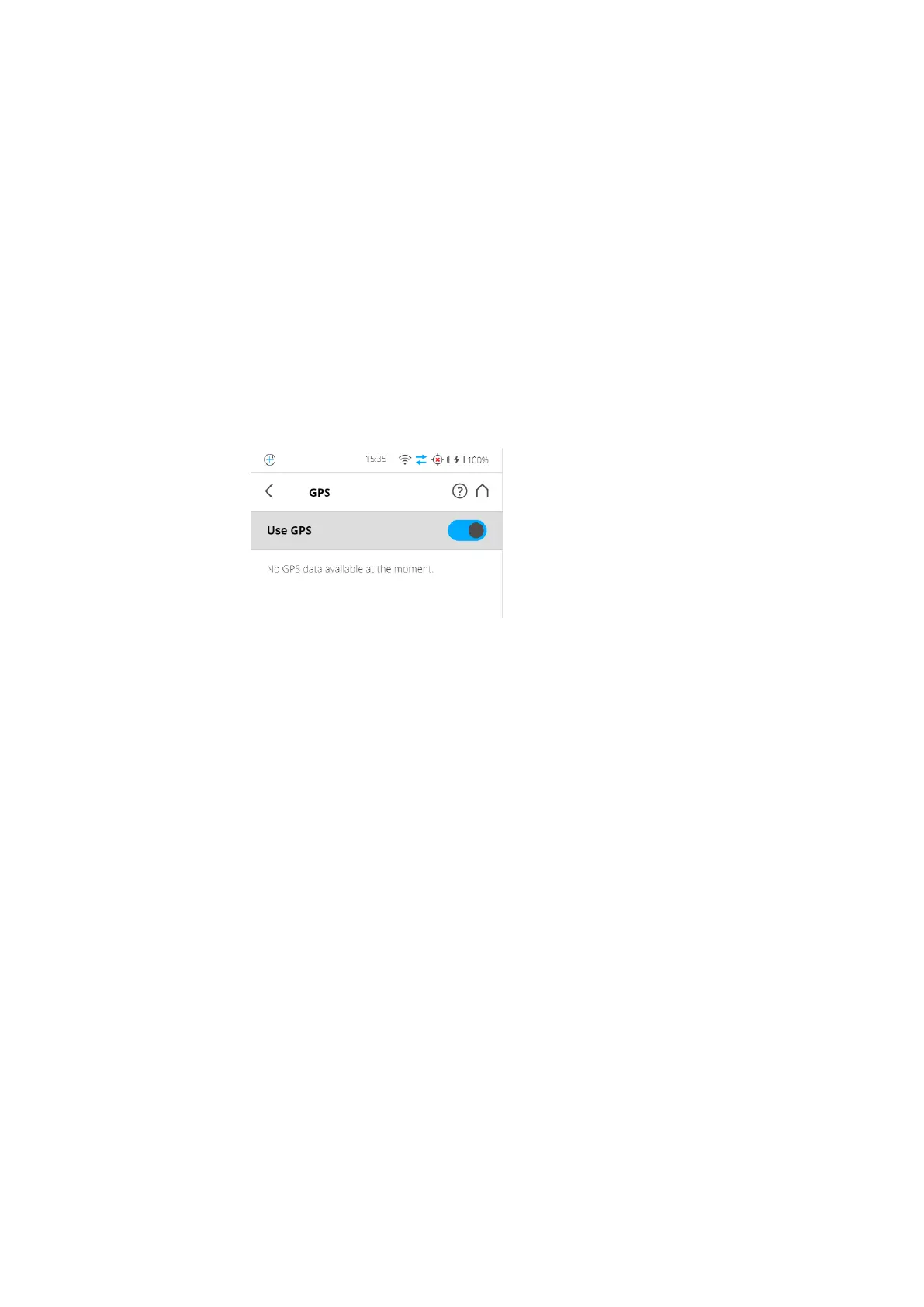
GPS
Figure 7-29: GPS
The position information of the scanner’s position provided by the built-in GPS
sensor is attached to each scan and is automatically used for the scan
registration in SCENE, if the use of the GPS sensor is switched ON.
Use GPS - Turn the GPS sensor ON or OFF. Unlike the other sensors, GPS
data is only recorded and attached to each scan if this sensor is turned ON.
This function is also available under Scanning Parameters.
For more information, see Setting the Scanning Parameters on page 44. After
the GPS sensor is switched ON, it automatically begins searching for GPS
satellites. Note that it can take some minutes to find all the available satellites
and to determine a precise position information. It is recommended to switch
the GPS sensor OFF if it is not needed or if a GPS signal is not available (for
example, if you are scanning indoor).
GPS information - Provides information about the currently measured GPS
coordinates latitude, longitude, and the altitude as well as the UTC time of the
last satellite contact and the number of satellites that are currently in view. The
GPS receiver needs the signal of at least three satellites to calculate a 2D
position (latitude and longitude). With four or more satellites in view, the
receiver can determine the scanner’s 3D position (latitude, longitude, and
altitude).
The signal strength bars below the GPS information appear for each satellite
in view with the appropriate satellite number underneath. They indicate the
signal strength for each satellite.



 To Next Page