69
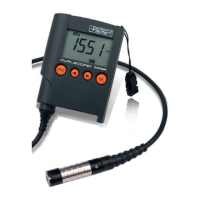
DMP30 / DMP40
Calibration
Before you start
The test parameters for the selected calibration are defined.
Defining the test settings, 71.
The probe is connected to the gauge containing the calibration you want to
check.
Reference piece and a calibration standard (calibration foil) already used for
the calibration procedure are ready. You can find the parts you need on the cal-
ibration info page: > Calibrations > OK > select name of calibration > OK > Info.
Before the control measurement is carried out, the gauge with connected probe
must have been switched on for at least 10 minutes! This is necessary to en-
sure that all gauge components have reached their operating temperature.
Otherwise, slightly increased measurement errors can occur!
If the calibration you want to check is locked, you need to know the lock code.
To check the desired calibration
1. Select the calibration whose measurement accuracy you want to check: >
Calibrations > OK > select name of calibration > OK.
2. Prompted to set the lock code?
• Yes: Set the lock code and deactivate the lock function, 73.
Function is deactivated:
• No: Continue with step 3.
3. Start the function: Check Calibration > OK.
4. Place the foil for the control measurement on the base material.
5. Take a few control measurements on the foil. We recommend taking 10
measurements. The circle on the foil marks the specified measurement area.
Description of the displayed variables on the Check Calibration page:
• Val.: Nominal value of the calibration standard (calibration foil), set in the
Def. Cal. Check menu.
• Δabs: Tolerance/uncertainty of the foil, set in the Def. Cal. Check menu.
• Nmin: Minimum number of required measurements
• : Arithmetic mean value, determined from the measurements taken; red
values are outside the tolerance limits
[ ]
[ ]
x






 To Next Page