Need help?
Do you have a question about the Flintec DAD143 Series and is the answer not in the manual?
Legal notice and rights reserved for the publication.
Crucial safety warnings and precautions for operating the equipment.
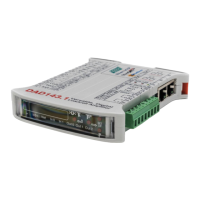
Details on the device's physical housing and terminal connections.
Specifics on connecting load cells to the device terminals.
Wiring guidelines and resistance requirements for load cell connections.
Information on power input terminals and voltage requirements.
Details on the RS232 service port for PC/PLC communication.
Description of the two RJ45 Ethernet ports and their specifications.
Explanation of the status and function of LED indicators on terminal 27.
Information about the seal switch and its role in calibration protection.
Configuration and function of the device's logic inputs and outputs.
Details on analog output configurations for current and voltage signals.
How to communicate with the DAD143.x via the RS232 service port.
Overview of the ASCII command format for device setup and parameter checking.
Information on setting the baud rate for RS232 communication.
Step-by-step guide to initiate communication using the RS232 port.
Guide to set up the device using an Ethernet port and Profinet Viewer.
Description of the function of each keyboard button on the device.
Instructions on navigating the setup menu using the front panel buttons.
Configuration settings for system zeroing, including tracking and calibration.
Settings related to system span calibration, including value and electronic input.
Configuration options for display limits, step size, and decimal point.
Settings for digital filters and motion detection parameters.
Configuration of analog output base, high/low levels, and mode.
Setup and function assignment for the device's logic inputs.
Configuration of setpoints, hysteresis, polarity, and testing for logic outputs.
Settings for baud rate, address, and auto-transmit modes for communication.
Procedure to reset the device to factory default settings.
List and explanation of error codes displayed on the device.
Step-by-step guide for calibrating the device using physical weights.
Guide for calibrating using load cell mV/V sensitivity data.
Commands for retrieving device identity, firmware version, and status information.
Comprehensive set of commands for device calibration procedures.
Commands for configuring motion detection to ensure signal stability.
Commands for setting digital filters, update rate, and pre-filter.
Commands for setting and resetting tare and zero values.
Commands for retrieving gross, net, tare, ADC, and data string values.
Commands to continuously send gross or net weight values.
Commands for assigning functions to and reading the status of logic inputs.
Commands for configuring and controlling logic outputs.
Commands for configuring communication parameters like address and baud rate.
Commands for configuring analog output base, high/low levels, and mode.
Commands for saving calibration, setup, setpoints, and analog output parameters.
Commands related to triggering measurement cycles, typically for checkweighing.
How to access and adjust metrological data using a traceable code.
Details on how metrological data and calibration are protected by a code (TAC).
Command and process for updating the main firmware of the DAD143.x.
Command to reset the device to its original factory default state.
Using software to back up and restore device configuration settings.
Command for selecting the communication protocol for the device.
Commands for configuring Ethernet network parameters.
Command to view the device's default gateway address.
Command to view the device's configured station name.
Command to view the device's assigned MAC addresses.
Structure and interpretation of the data package sent from the DAD to the PLC, including status and data variables.
Structure of the data package sent from the PLC to the DAD, including command and data fields.
Example of reading the DAD serial number using an acyclic Profinet request.
Explanation of the Profinet status code structure and error values.
 General
| Protection class | IP65 |
|---|---|
| Repeatability | ± 0.01 % of Rated Output |
| Safe Overload | 150 % of Rated Capacity |
| Ultimate Overload | 300 % of Rated Capacity |
| Output | 2 mV/V |
| Compensated Temperature Range | -10°C to +40°C |

 To Next Page