112
fi g. 8.18
fi g. 8.19
fi g. 8.20
fi g. 8.21
fi g. 8.22
B
A
C
8 - A
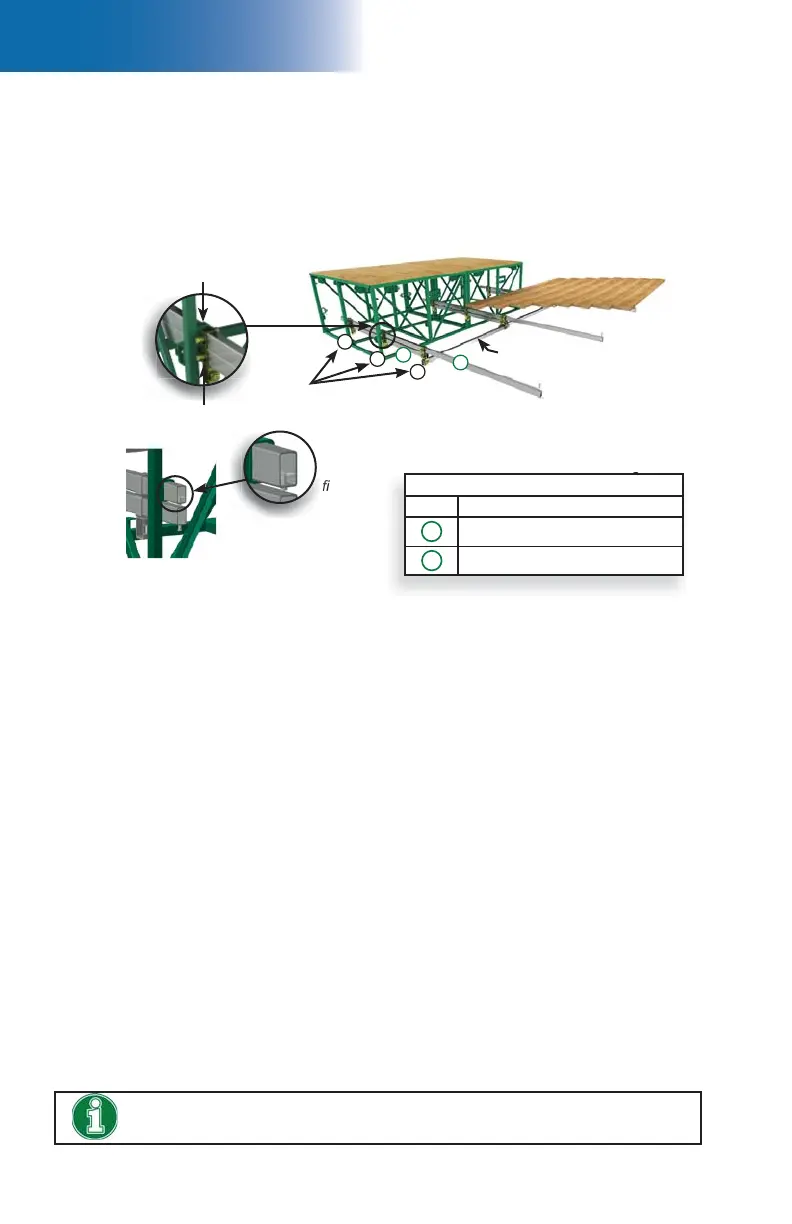
1- Remove the clevis pin and the plank stop pin from the longest outrigger (fi g. 8.18).
Insert the outrigger in the bottom outrigger pocket located on the front truss of the
motorized unit or bridge.
2- Slide the top section of a cross box on the back of the outrigger (“A” in fi g. 8.18).
Push the outrigger into the bottom outrigger pocket located on the middle truss of the
motorized unit or bridge.
3- Slide the top section of a second cross box on the front of the outrigger (“B” in fi g. 8.18)
until it is snug against the front outrigger pocket (fi g. 8.19).
4- Remove the clevis pin and the plank stop pin and slide the second outrigger into the
middle section of all the cross boxes until its rear end is in by about 6" (15 cm) from
the rear end of the top outrigger.
5- Insert a clevis pin into the top outrigger (fi g. 8.22) and pull it up until its head is snug
against the outrigger.
6- Still holding up the clevis pin on the top outrigger, pull out the bottom outrigger until both
outriggers are even (fi g. 8.21). Secure the clevis pin on the top outrigger with a hitch pin
clip. Insert a clevis pin in the bottom outrigger and secure it in place with a hitch pin clip.
7- Slide the top section of a third cross box on the front of the top and bottom outriggers until
it is even with the end of the bottom outrigger (fi g. 8.22).
8- Repeat steps 1 through 7 for each doubled outrigger required.
9- Once all required doubled outriggers are installed, slide a cross outrigger through the
bottom section of the cross boxes on the end of the doubled outriggers (fi g. 8.18).
10- Tighten the bolts on all the outrigger pockets and on the top and middle sections of the
cross boxes to a torque of 30 lb-ft (41 N-m).
Outriggers
Doubled outriggers
(optional)
Planking confi gurations of six, seven and eight planks wide require the use of doubled
outriggers and optional cross boxes. A doubled outrigger can be a combination of a longer,
thicker outrigger doubled with a standard 63" (1,6 m) or 72" (1,8 m) outrigger. Refer to the
Outrigger Selection table on p. 111 for more information on the outrigger size required
for each planking confi guration.
Any outrigger according
to requirements
When using outriggers of diff erent length,
it is important to make sure the longest
one is used on top of the shortest one
Cross boxes
Installation
A doubled outrigger can be a combination of a longer, thicker outrigger doubled with a standard
63" (1,6 m) or 72" (1,8 m) outrigger.
Clevis pin must
be held up to
clear the bottom
outrigger
Outriggers Required For Doubling
Ref Outrigger
2 1/2" x 1 1/2" x 1/8" x 63"
(6,4 cm x 3,8 cm x 0,3 cm x 160 cm)
2 1/2" x 1 1/2" x 1/4" x 120"
(6,4 cm x 3,8 cm x 0,6 cm x 305 cm)
63
120
63
120
Bottom outrigger
pocket on bridge
Middle section
on cross box
View from back of bridge



 To Next Page