92
fi g. 6.28
fi g. 6.29
fi g. 6.30
fi g. 6.31 fi g. 6.32
fi g. 6.33
fi g. 6.34
fi g. 6.35
fi g. 6.37
X
Y Z
fi g. 6.36
6 - M M T
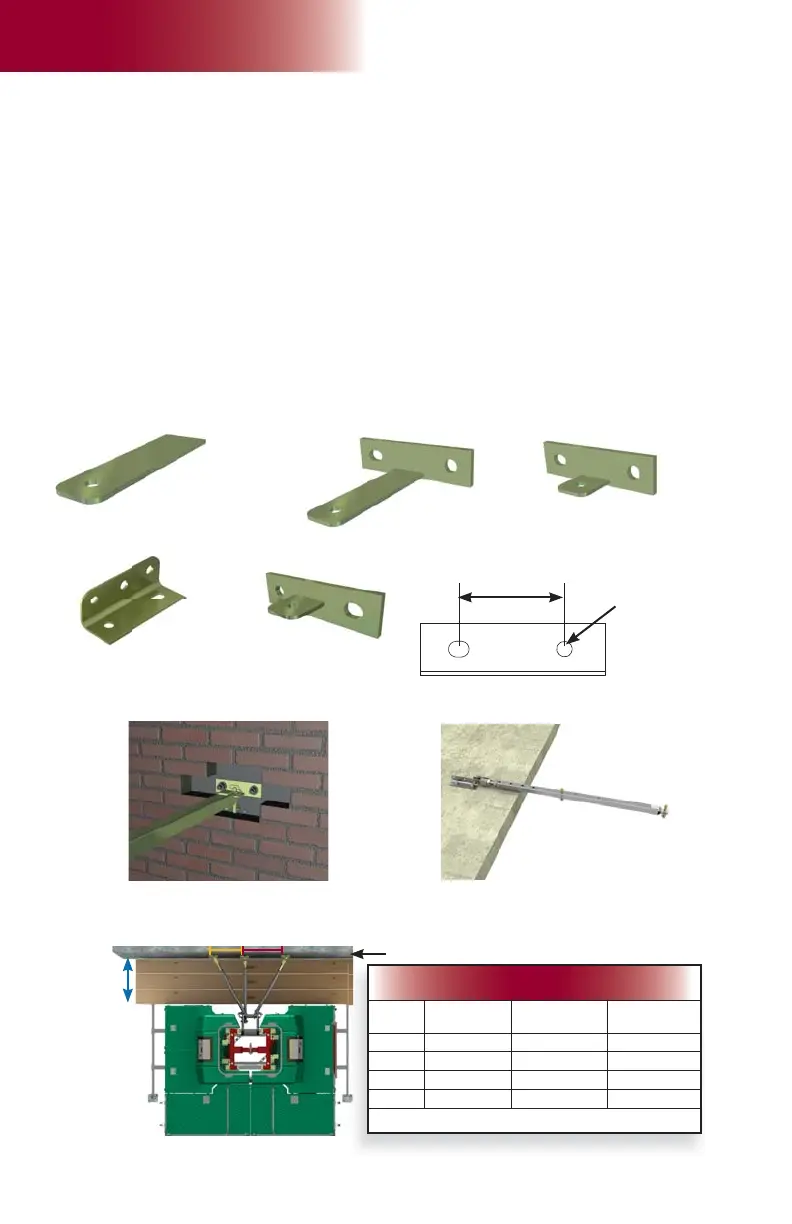
Before attaching masts to the building using the mast tie system, wall ties must be installed
on a solid component of the building structure. It is important to understand that whether
the anchoring installation is a vertical or horizontal type (fi g. 6.34 and fi g. 6.35), values for
tension / compression and shear forces will be inverted.
Concrete slabs, columns, steel beams, relief angles and other structural elements can
be used provided they and the anchoring system chosen can sustain 3000 lb (1361 kg)
of tension / compression and 1500 lb (680 kg) of shear force for a vertical anchoring
installation and 1500 lb (680 kg) of tension / compression and 3000 lb (1361 kg) of shear
force for a horizontal anchoring installation.
Wall tie reactions
Anchoring System
Wall tie for horizontal
or vertical anchoring
installation
Welded wall tie
Re-usable wall tie
(off set)
Fixed wall tie
(4" or 10 cm only)
Re-usable wall tie
(centered)
Horizontal anchoring
installation
Vertical anchoring
installation
5 1/8" (13 cm)
Ø 3/4" (1,9 cm)
Wall tie bracket template
Mast and Mast Ties
Wall tie types
There are 4 types of wall ties that can be used – welded, fi xed, re-usable (centered or
off set) and for horizontal/vertical installation. As the installation is rising, install the wall ties
as per the appropriate mast tie schedule (see p. 87).
Wall tie distance
for a vertical anchoring installation
Number of
planks
X
in (cm)
Y
in (cm)
Z
in (cm)
─ 7" (17,8 cm) 5" (12,7 cm) 13 1/2" (34,3 cm)
1 17" (43,2 cm) 9 1/2" (24,1 cm) 18 1/2" (47 cm)
2 27" (68,6 cm) 14" (35,6 cm) 23" (58,4 cm)
3 37" (94 cm) 19" (48,3 cm) 27 1/2" (68,9 cm)
Distances above are given as a reference only.
Wall



 To Next Page