29
5
REPEATER AND DUPLEX OPERATIONS
1
2
3
4
5
6
7
8
9
10
11
12
13
14
15
16
17
18
19
N Repeater operation
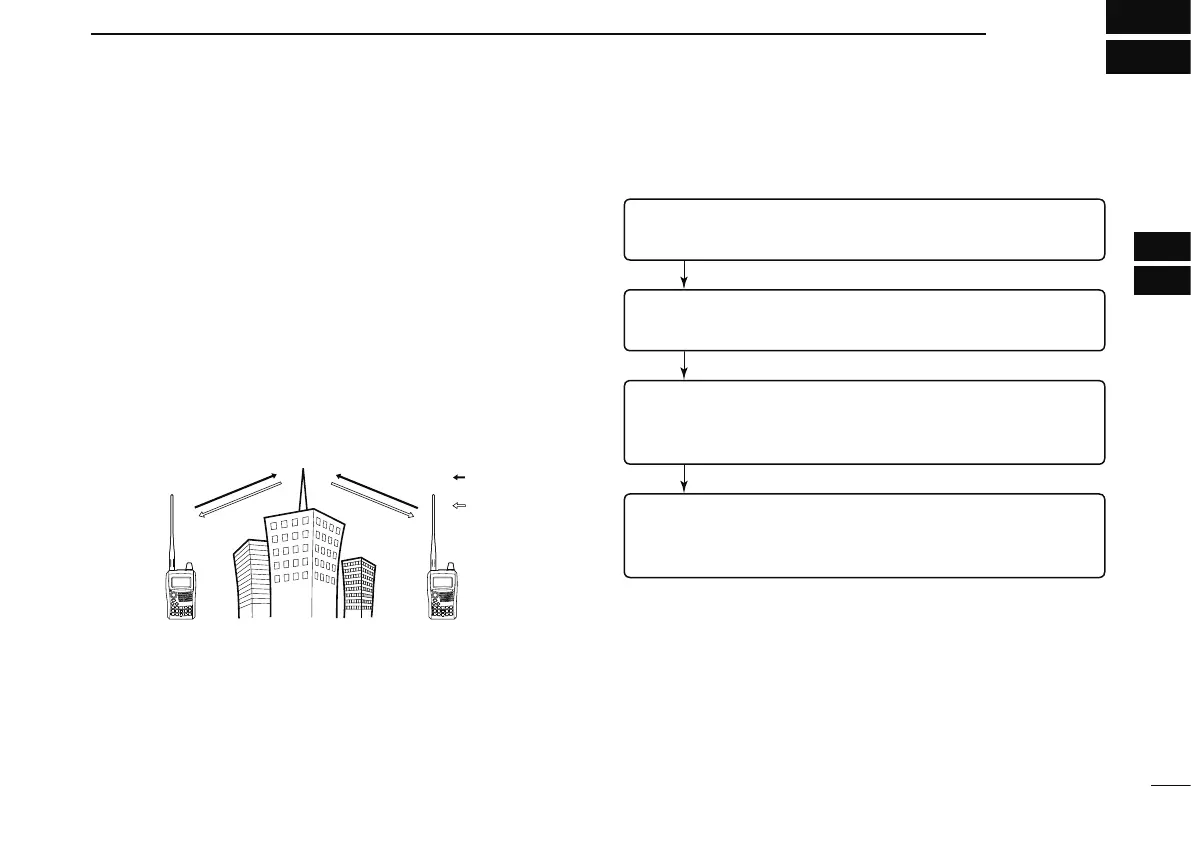
Repeaters allow you to extend the operational range of your
radio because a repeater has much higher output power than
the typical transceiver.
Normally, a repeater has independent frequencies for each
receiver and transmitter.
A subaudible tone may also be required to access a re-
peater.
Reference amateur radio handbooks and local ham maga-
zines for details of local repeaters such as repeater input/out-
put frequencies and locations.
Station A
Station B
Repeater
439.540 MHz
434.540 MHz
434.540 MHz
439.540 MHz
Uplink
Downlink
(transmitting freq.)
(receiving freq.)
• Repeater operation flow chart
• Repeater settings can be stored into a memory channel. (p. 94)
Step 2:
Step the desired receive frequency (repeater output frequency).
Step 3:
Set the duplex (shift) direction (– duplex or +duplex).
- Set the frequency offset (amount of shift), if required.
Step 4:
Set the subaudible tone (repeater tone) encoder function ON.
- Set the subaudible tone frequency, if required.
Step 1:
Step the desired band to operate the repeater.


 To Next Page