31
5
REPEATER AND DUPLEX OPERATIONS
1
2
3
4
5
6
7
8
9
10
11
12
13
14
15
16
17
18
19
D Checking the repeater input signal
The transceiver can check whether the other station’s trans-
mit signal can be received directly or not, by listening on the
repeater input frequency.
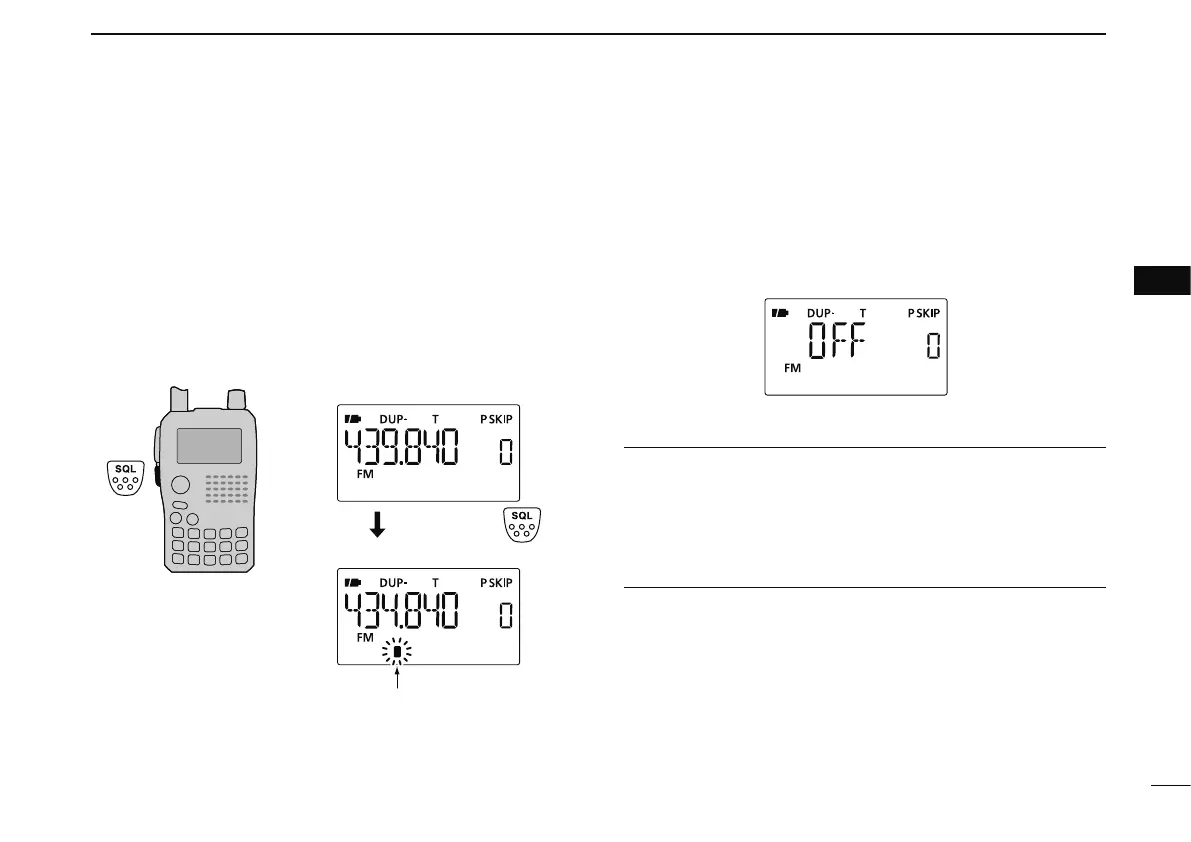
± Push and hold [SQL] to check whether the other station’s
transmit signal can be received directly or not.
• When the other station’s signal can be directly received, move
to a non-repeater frequency to use simplex. (duplex OFF)
Indication while receiving
Receives –5 MHz shift frequency
Blinks while pushing and holding [SQL]
Push and hold
D Off band indication
If the transmit frequency is out of the amateur band, the off
band indication, “OFF,” appears on the display when [PTT] is
pushed. Check the frequency offset or duplex direction in this
case.
(p. 32)
CONVENIENT!
Tone scan function: When you don’t know the subaudible
tone used for a repeater, the tone scan is convenient for de-
tecting the tone frequency.
± Push and hold [T.SCAN](9) for 1 sec. to start the tone
scan. See p. 152 for more information.


 To Next Page