6 Technical data
Noise emission values
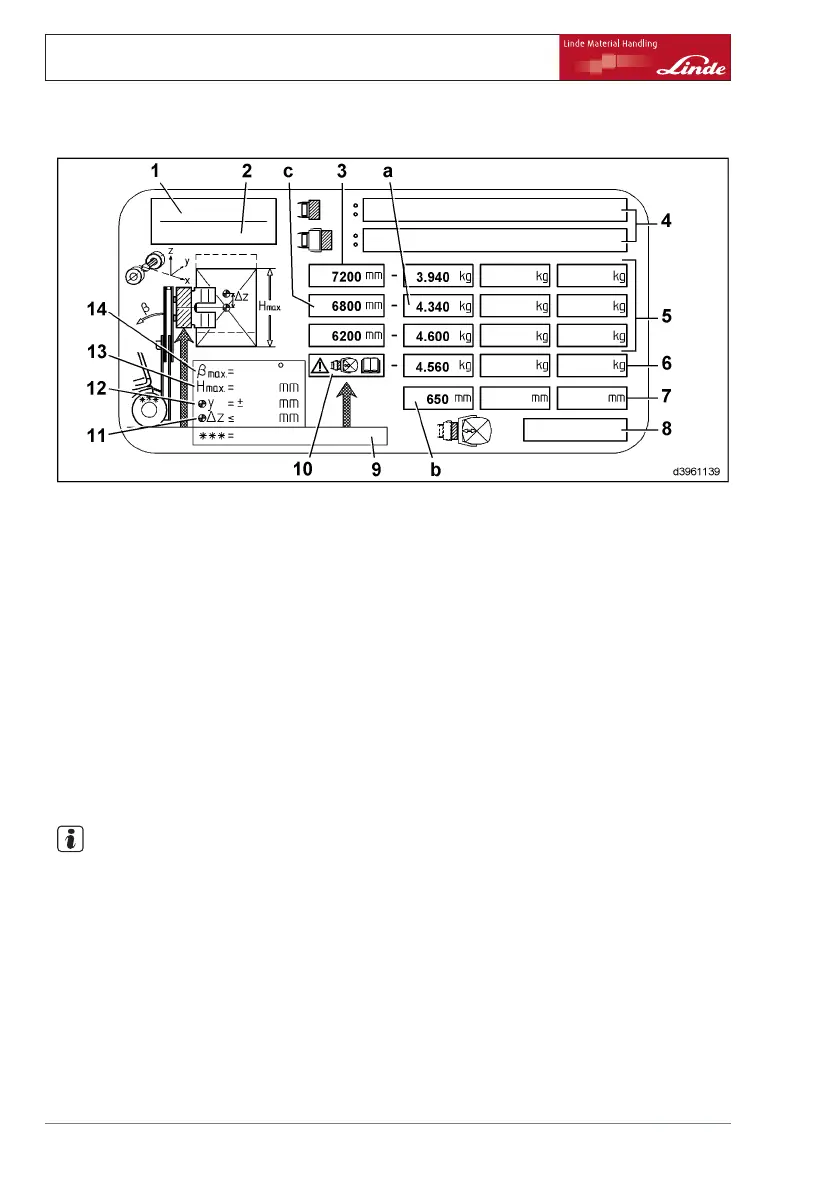
Additional capacity rating plate for attachments with loads that are fixed or clamped
1 Truck series (year of manufacture, from - to)
2 Lift mast type (series)
3 Lift heights
4 Attachments
5 Load capacities
6 Reduced load capacities
7 Load centres of gravity
8 Reference number and note about person
calculating the load capacity
9 Front tyres
10 Note — If there is sufficient visibility for
forwards travel when transporting loads,
we recommend that the calculated residual
load capacity based on the roller height /
load height (value = maximum permissible
load height (13)) is limited to the following in
order to achieve a more dynamic driving
behaviour: at a load centre of gravity
650 mm = 4,560 kg.
11 Specifies in mm how much the load centre
of gravity is offset vertically upwards to the
centre of the attachment (e.g. roller / bale
taken off).
Also applicable for attachments with a rotate
function: The actual centre of gravity of the
load during rotation must not lie outside the
pivot point by more than 100 mm (truck rated
capacity ≤ 6300 kg) or 150 mm (truck rated
capacity > 6300 kg and ≤ 10,000 kg)!
12 Maximum permissible centre offset of load
13 Maximum permissible load height
14 Maximum permissible backward tilt of lift
mast
N
OTE
E
xample for reading the load capacity:
•
a
= 4340 kg at load centre of gravity b =
6
50 mm to lift height c = 6800 mm.
Noise emission values
Calculated in the test cycle in accordance with
EN 12053 from the weighted values for the
TRACTION, LIFT and IDLING modes.
248 Operating Instructions – 394 807 10 01 EN – 07/2011



 To Next Page