320
Operation
Tires and wheels
In addition to the Tire and Loading Infor-
mation placard on the driver’s door B-pil-
lar, also consult the fuel filler flap for any
additional information pertaining to
special driving situations. For more infor-
mation, see “Important notes on tire in-
flation pressure” (
컄 page 320).
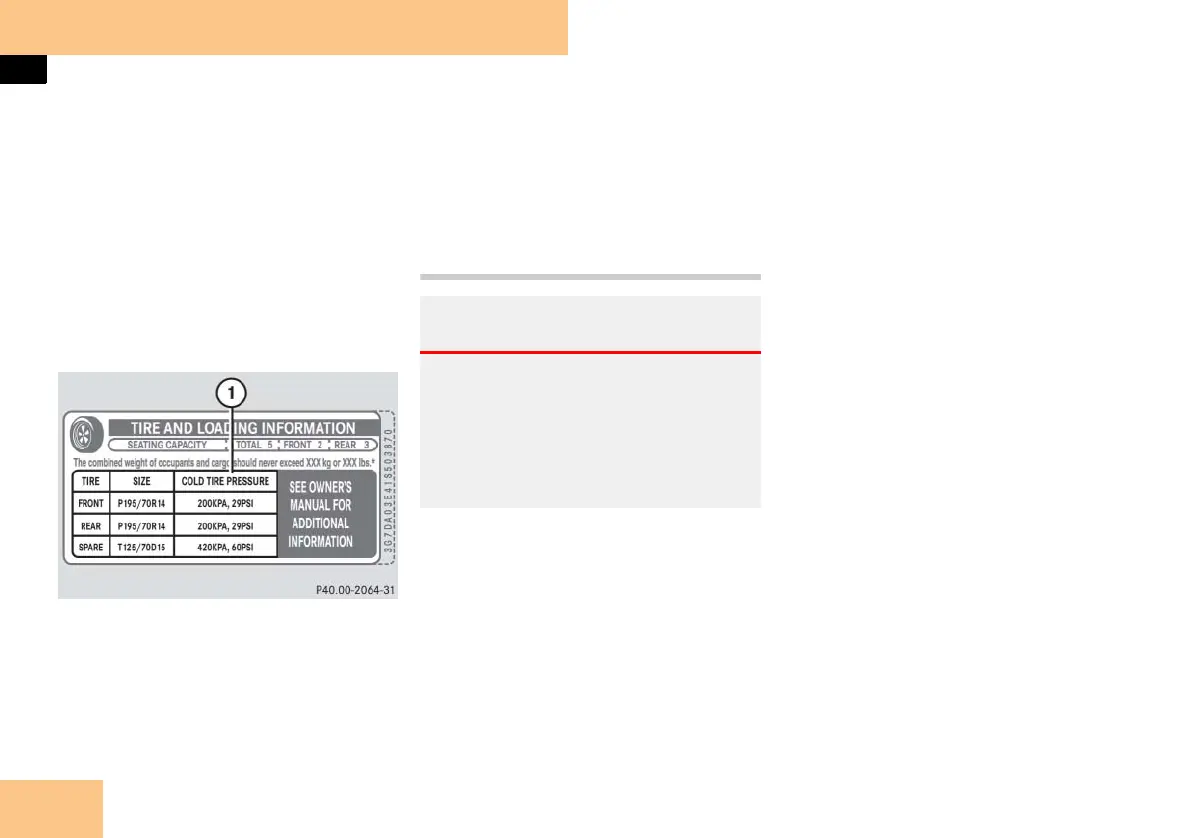
i Data shown on placard example are for il-
lustration purposes only. Load limit data are
specific to each vehicle and may vary from
data shown in the illustration below. Refer to
placard on vehicle for actual data specific to
your vehicle.
1 Tire and Loading Information placard
with recommended cold tire inflation
pressures
The Tire and Loading Information plac-
ard lists the recommended cold tire infla-
tion pressures for maximum loaded
vehicle weight. The tire inflation pres-
sures listed apply to the tires installed as
original equipment.
Important notes on tire inflation
pressure
Tire temperature and tire inflation pres-
sure are also increased while driving, de-
pending on the driving speed and the
tire load.
If you will be driving your vehicle at high
speeds of 100 mph (160 km/h) or higher,
where it is legal and conditions allow,
consult the placard on the inside of the
fuel filler flap on how to adjust the cold
tire inflation pressure. If you do not ad-
just the tire inflation pressure, excessive
heat can build up and result in sudden
tire failure.
i Driving comfort may be reduced when
the tire inflation pressure is adjusted to the
value for speeds above 100 mph (160 km/h) as
specified on the placard located on the inside
of the fuel filler flap.
Be sure to readjust the tire inflation
pressure for normal driving speeds. You
should wait until the tires are cold before
adjusting the tire inflation pressure.
Some vehicles may have supplemental
tire inflation pressure information for
vehicle loads less than the maximum
loaded vehicle condition. If such infor-
mation is provided, it can be found on
the placard located on the inside of the
fuel filler flap.
Tire inflation pressure changes by ap-
proximately 1.5 psi (0.1 bar) per 18°F
(10°C) of air temperature change. Keep
this in mind when checking tire inflation
pressure where the temperature is dif-
ferent from the outside temperature.
Warning! G
If the tire inflation pressure repeatedly
drops:
앫 Check the tires for punctures from
foreign objects.
앫 Check to see whether air is leaking
from the valves or from around the
rim.



 To Next Page