3.20.2 Fault Counting
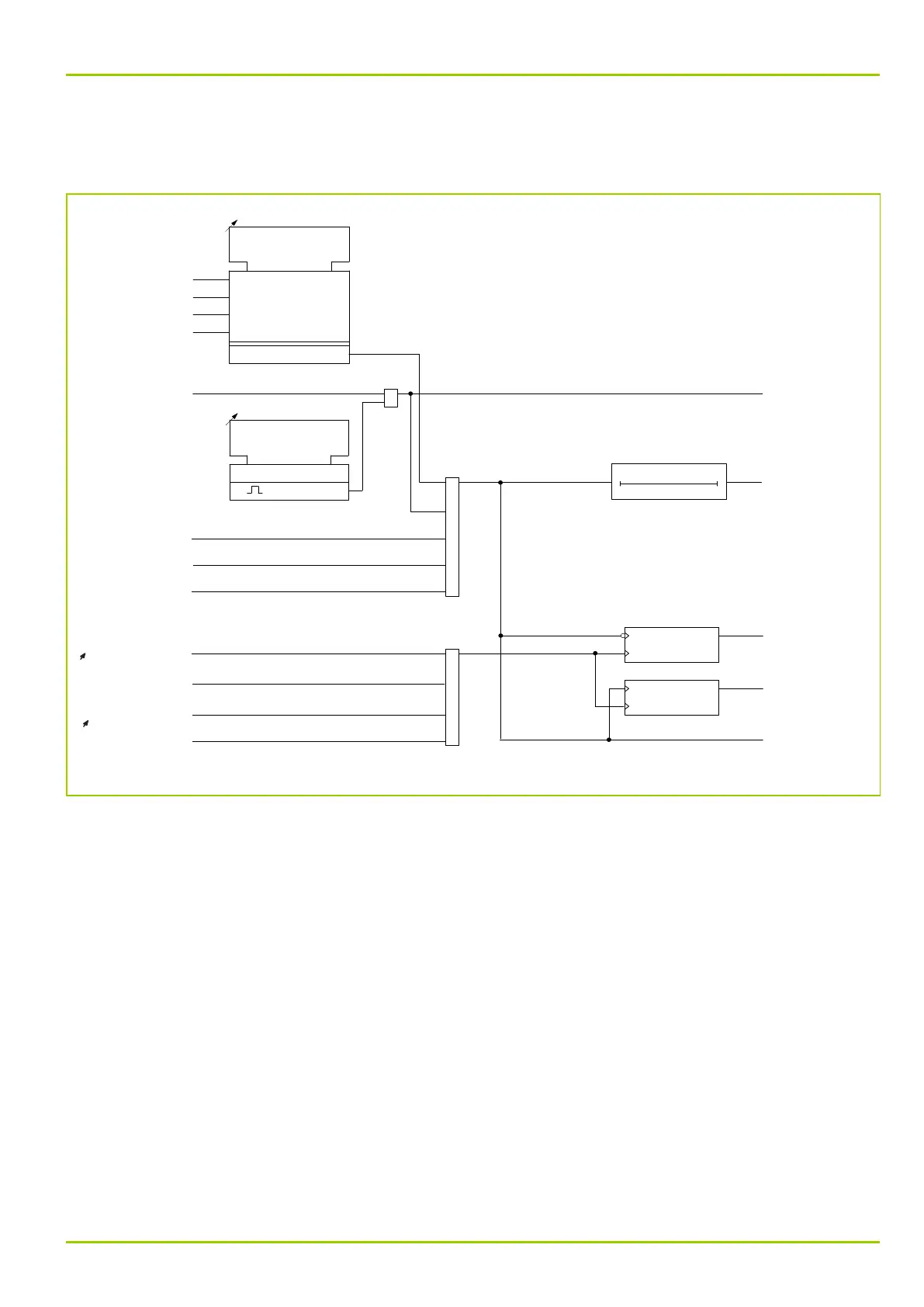
Faults are counted and identified by sequential numbers.
64Z8025A
1: execute
1: execute
≥1
≥1
≥1
MAIN:
Gen. trip signal 2
[ 036 023 ]
MAIN:
General reset EXT
[ 005 255 ]
FT_RC:
Reset record. USER
[ 003 006 ]
FT_RC:
Trigger EXT
[ 036 089 ]
FT_RC:
Record. in progress
[ 035 000 ]
FT_RC:
No. of faults
[ 004 020 ]
FT_RC:
No. system disturb.
[ 004 010 ]
FT_RC:
System disturb. runn
[ 035 004 ]
MAIN:
Gen. trip signal 1
[ 036 005 ]
MAIN:
General reset USER
[ 003 002 ]
FT_RC:
Trigger USER
[ 003 041 ]
0
1
0: don't execute
1: execute
R
+
R
+
FT_RC:
Fct. assig. trigger
[ 003 085 ]
m out of n
Signal 1
Signal 2
Signal 3
Signal n
Selected signals
FT_RC:
Trigger
[ 037 076 ]
FT_RC:
Reset record. EXT
[ 005 243 ]
0 1 min
MAIN:
General starting
[ 036 000 ]
Fig. 3-74: Start of fault recording and fault counter.
3.20.3 Time Tagging
The date that is assigned to each fault by the internal clock is stored. A fault’s
individual start or end signals are likewise time-tagged. The date and time
assigned to a fault when the fault begins can be read out from the fault memory
on the local control panel or through the PC and communication interfaces. The
time information (relative to the onset of the fault) that is assigned to the signals
can be retrieved from the fault memory or through the PC or communication
interfaces.
3 Operation
P631
P631/EN M/R-11-C // P631-310-650 3-105


 To Next Page