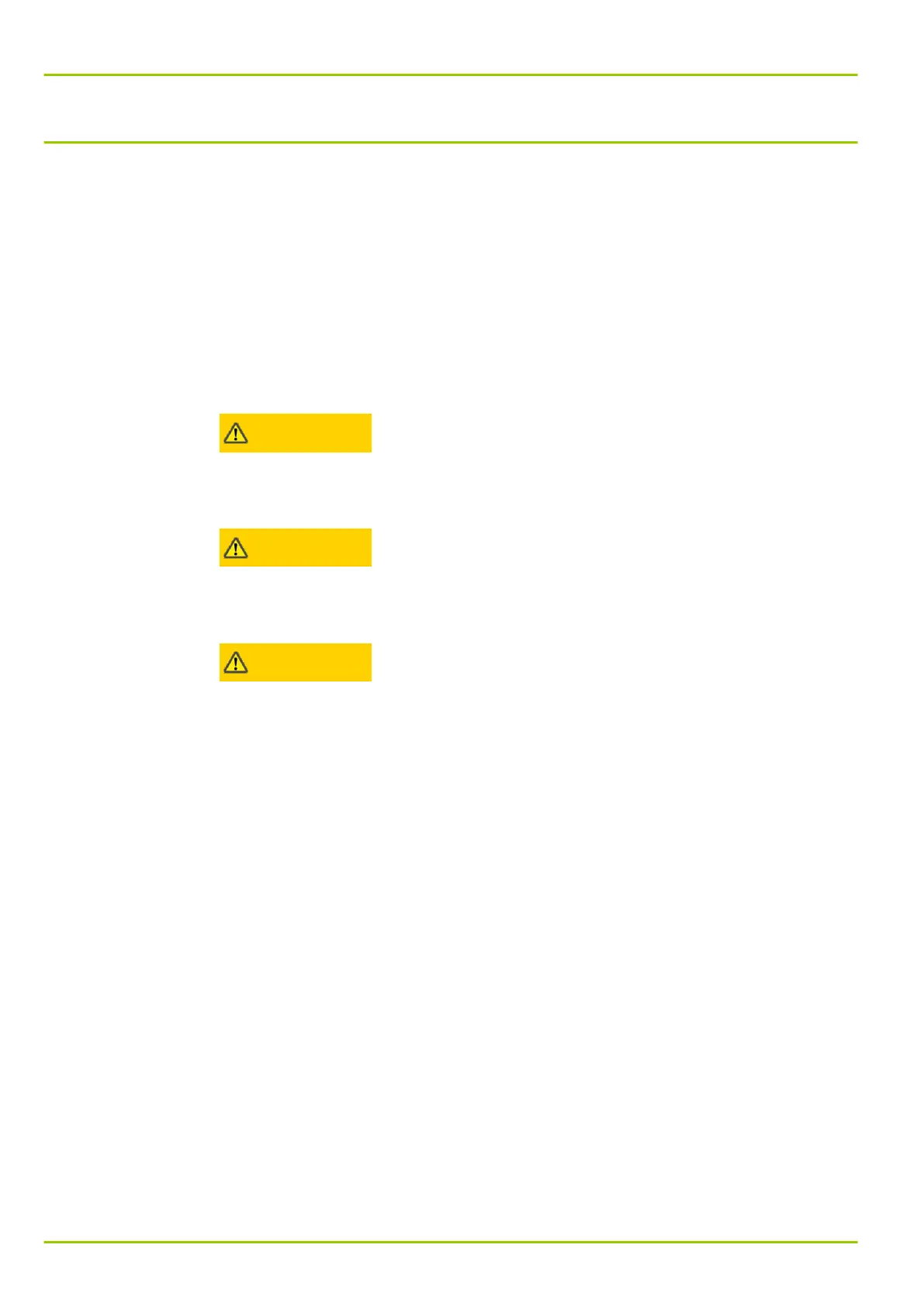
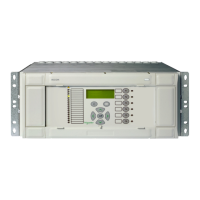
4.1 Designs
The P631 is available in a surface-mounted and a flush-mounted case. Depending
on the connection type – pin-terminal or ring-terminal connection – the case sizes
differ. The location diagrams (Section 5.7, (p. 5-18)) show the available
combinations of case widths and connection types.
Electrical connections are made via plug-in threaded terminal blocks. The
threaded terminal blocks in the surface-mounted case are accessible from the
front of the device after unscrewing the crosshead screws on the sides (see
Fig. 4-1, (p. 4-3), ➀) and removing the local control panel. The local control
panel can then be secured by inserting the tabs in the slots in the left side wall
(see Fig. 4-1, (p. 4-3), ➁). The flush-mounted case is connected at the back of
the case.
Warning!
⚫
The local control panel is connected to processor module P by a plug-in
connecting cable. Do not bend the connecting cable! Secure the local control
panel by inserting it in the slots provided on the left.
Warning!
⚫
The secondary circuit of live system current transformers must not be opened!
If the secondary circuit of a live CT is opened, there is the danger that the
resulting voltages will endanger personnel and damage the insulation.
Warning!
⚫
For pin-terminal connection devices, the terminal block for system current
transformer connection is not a shorting block! Therefore always short-circuit
the system current transformers before loosening the threaded terminals.
P631
4 Design
4-2 P631/EN M/R-11-C // P631-310-650


 To Next Page