IED
Processor module
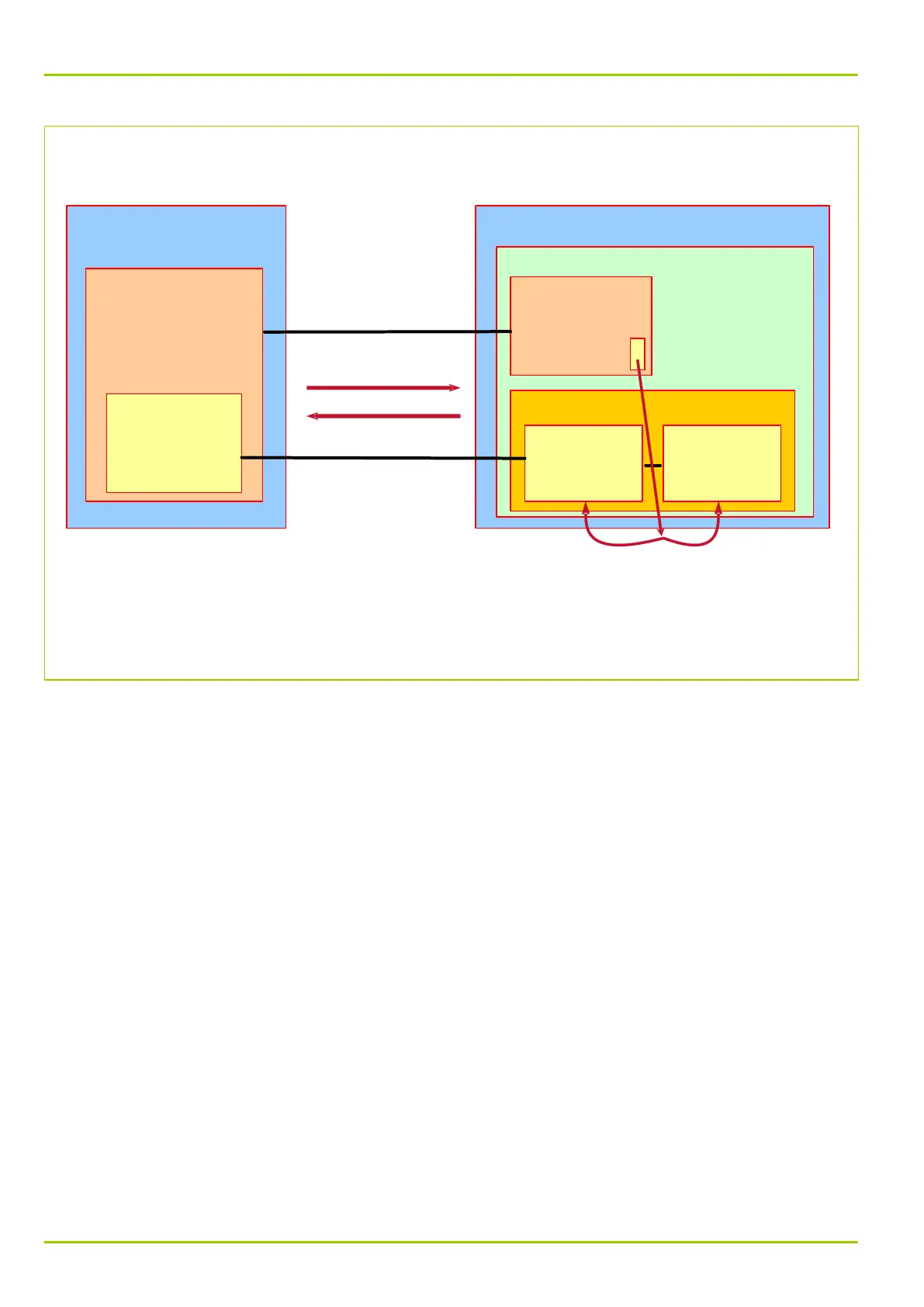
IEC 61850 parameters separate from protection device parameters!
New approach to IED parameter management
Control PC
Parameter download
Parameter upload
Operating program
IED
Configurator
Device
parameters
Ethernet module
IEC 61850
parameter
Bank 1
Bank 2
Bank switching to enable the
device parameters
Parameter
switch
IEC 61850
parameter
19Z7002B
Fig. 3-17: Saving configuration parameters.
3.4.4.1.4 Client Log-on
Communication in Ethernet no longer occurs in a restrictive master slave system,
as is common with other protocols. Instead, server or client functionalities, as
defined in the “Abstract Communication Service Interface” (ACSI, IEC 61870‑7‑2),
are assigned to the devices. A “server” is always that device which provides
information to other devices. A client may log on to this server in order to receive
information, for instance “reports”. In its function as server the P631 can supply
up to 16 clients, linked into the network, with spontaneous or cyclic information.
3.4.4.1.5 Clock Synchronization
With IEC 61850 clock synchronization is effected via the SNTP protocol, defined
as standard for Ethernet. Here the P631 functions as an SNTP client.
For clock synchronization one can choose between the operating modes Anycast
from SNTP Server or Request from Server. With the first operating mode
synchronization occurs by a broadcast message sent from the SNTP server to all
devices in the network, and in the second operating mode the P631 requests a
device-specific time signal during a settable cycle.
Two SNTP servers may be set. In this case, clock synchronization is preferably
performed by the first server. The second server is only reverted to if no signal is
received from the first server.
When looking at the source priority for clock synchronization, which is set at the
MAIN function then, by selecting COMM1, synchronization per IEC 61850 is
automatically active but only if this communication protocol is applied.
P631
3 Operation
3-24 P631/EN M/R-11-C // P631-310-650


 To Next Page