Antenna interfaces can be connected to a rubber ducky antenna, magnet antenna, or embedded
Planar Inverted F Antenna (PIFA). Keep external RF wires far away from all disturbing sources,
especially digital signals and DC/DC power if using RF wires.
The following methods are commonly used to assemble antenna:
⚫
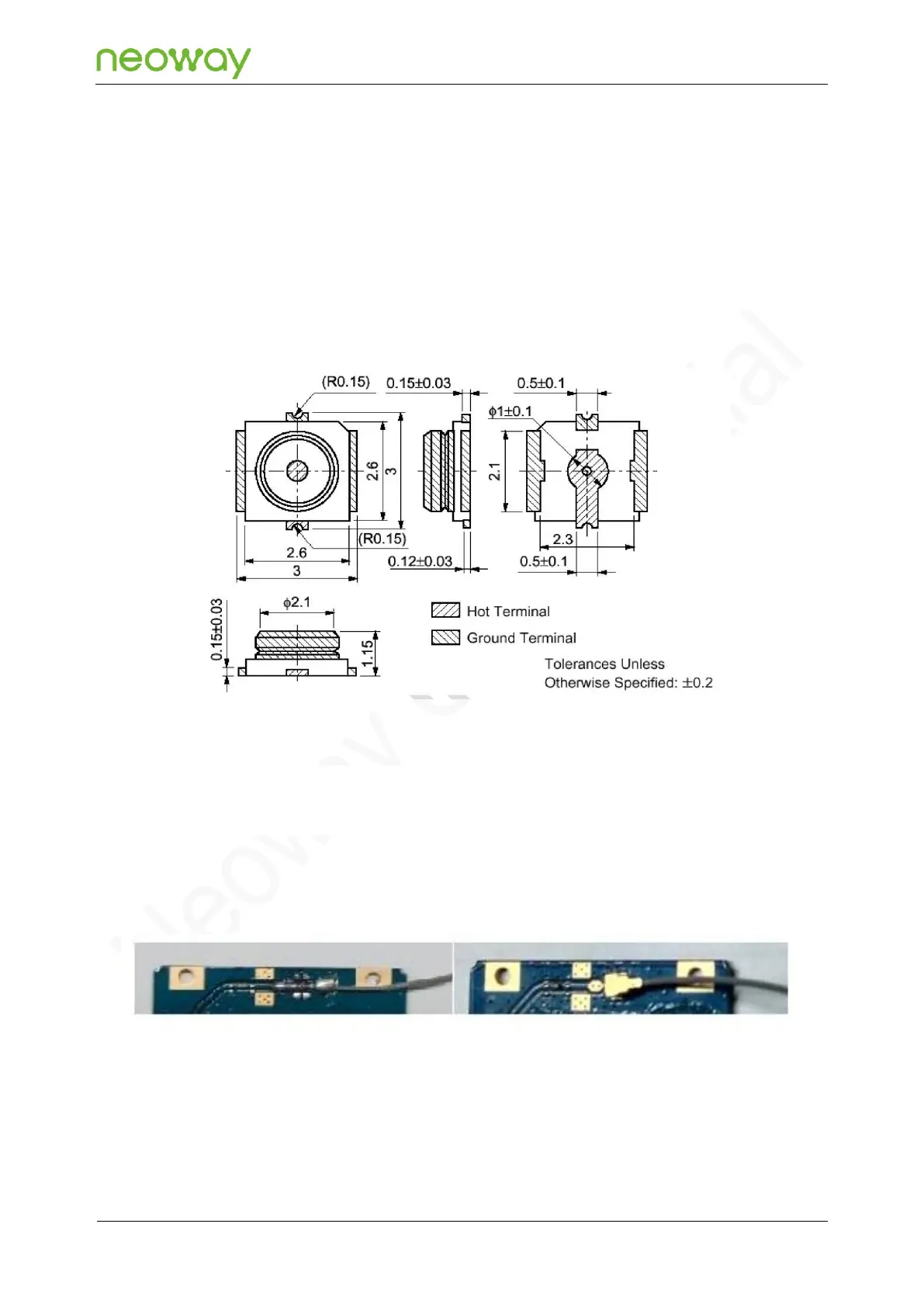
GSC RF connector
MM9329-2700RA1 from Murata is recommended. The following figure shows its encapsulation
specifications.
Figure 5-35 Murata RF connector encapsulation specifications
⚫
The RF cable is connected to the module by means of soldering. However, this method has the
stability, consistency, and RF performance degradation issues, and therefore is not
recommended.
The following figure shows the effect of the connection methods.
Figure 5-36 RF cable connections
⚫
PCB Printing or SMT
The module works in a wide frequency range, but it is difficult for PCB antennas or ceramic
antennas to cover a wide frequency. Therefore, this connection method is recommended only for
2.4 GHz Wi-Fi or BT/ BLE antennas.



 To Next Page