109
Saturation pulse count
Set up screen #1
Saturation pulse interval
Set up screen #1
Fo’ or Fod mode
“Flash Interval” is the time between flashes. According to
Roseqvist and van Kooten (2006) saturation pulses must be 60 to
120 seconds apart, in higher plants, to ensure that saturation flash
NPQ is fully dissipated. If it is not, the Fm’ peaks will continue to
decline from one flash to the next as the saturation flash NPQ
builds up. F may also rise. To prevent this, one can do test the
sample, or use 120 seconds to be safe.
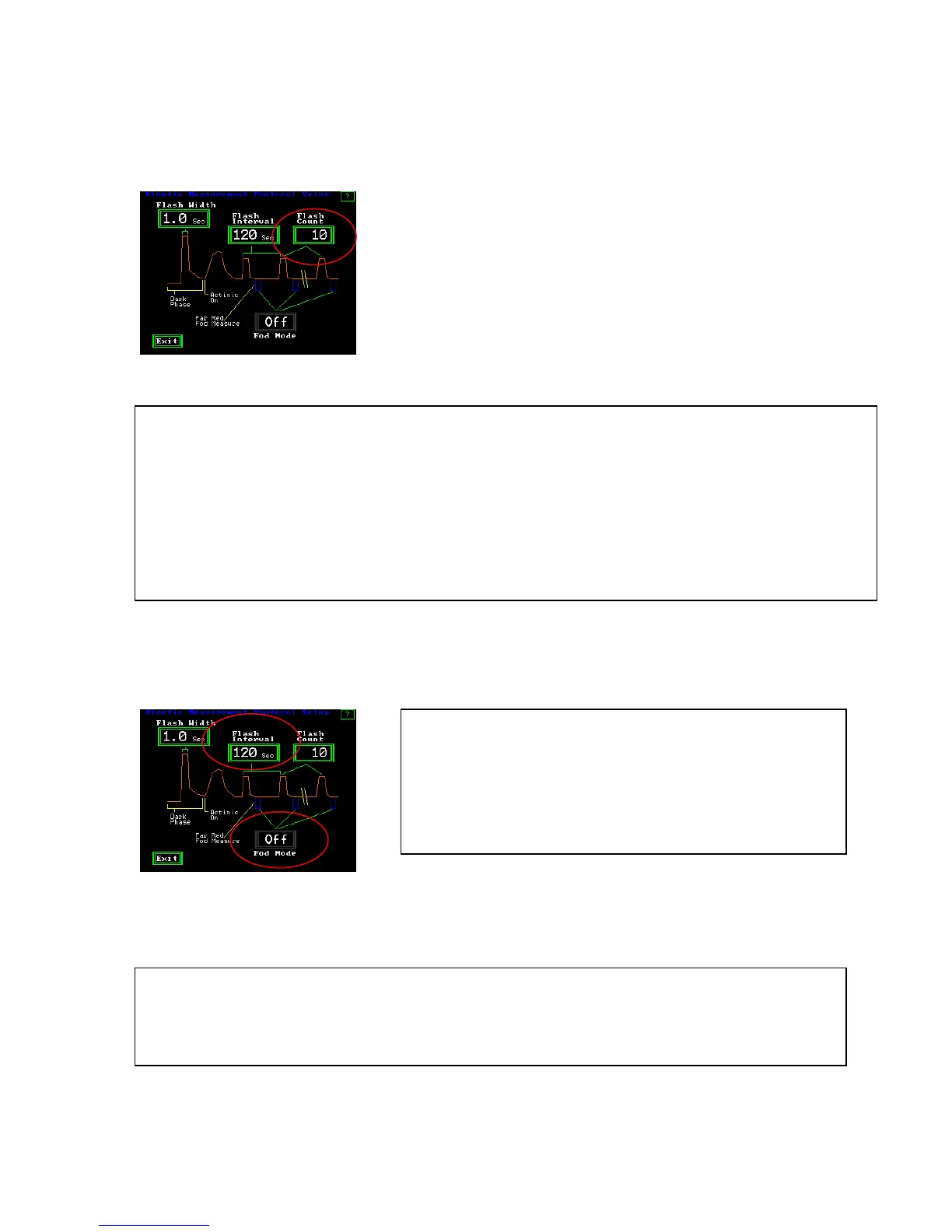
Flash Count has been set at 10. To get reliable quenching measurements, the leaf must be at steady state
photosynthesis, a process that takes between fifteen and twenty minutes at a constant actinic light level. Ten
flashes with an interval of 120 seconds allows twenty minutes at a set light level before the quenching
measurement is made. For extra safety, changing the flash count to 15 may improve results. The LED actinic light
source output declines up to thirteen percent as it heats up.
Most of the change in light output occurs over the first five minutes. By adding the extra flashes, the change in the
intensity is minimized and becomes insignificant. If the PAR Clip is used with a shroud, or the measurement is
made in a darkened room with a PAR Clip, or pre-Dawn measurements are made with a PAR Clip, the intensity
change is recorded with the measurement.
Fod Mode – Fod mode or Fo’ mode is used with the Kramer and puddle model protocols only. It is not used
with the Hendrickson –Klughammer protocol. When used, it allows the measurement of Fo’ at the end of the
trace or after every saturation pulse. Knowledge of Fo’ (or Fod) is required for most Kramer parameters, and
for qN in the puddle model.


 To Next Page