166
Resolution ± 0.1
o
C.
PAR Sensor: GaAs sensor, Cosine Corrected
Range 0 ~ 3000 :E or :mols
Resolution +
/-
2 :E or :mols
Cosine Corrected to 80 degrees
The PAR Clip is calibrated To a Licor L-190 Quantum Sensor at the factory. The L190
calibration is traceable to National Institute of Standards and Technology. They should
be returned to the factory every two years for recalibration.
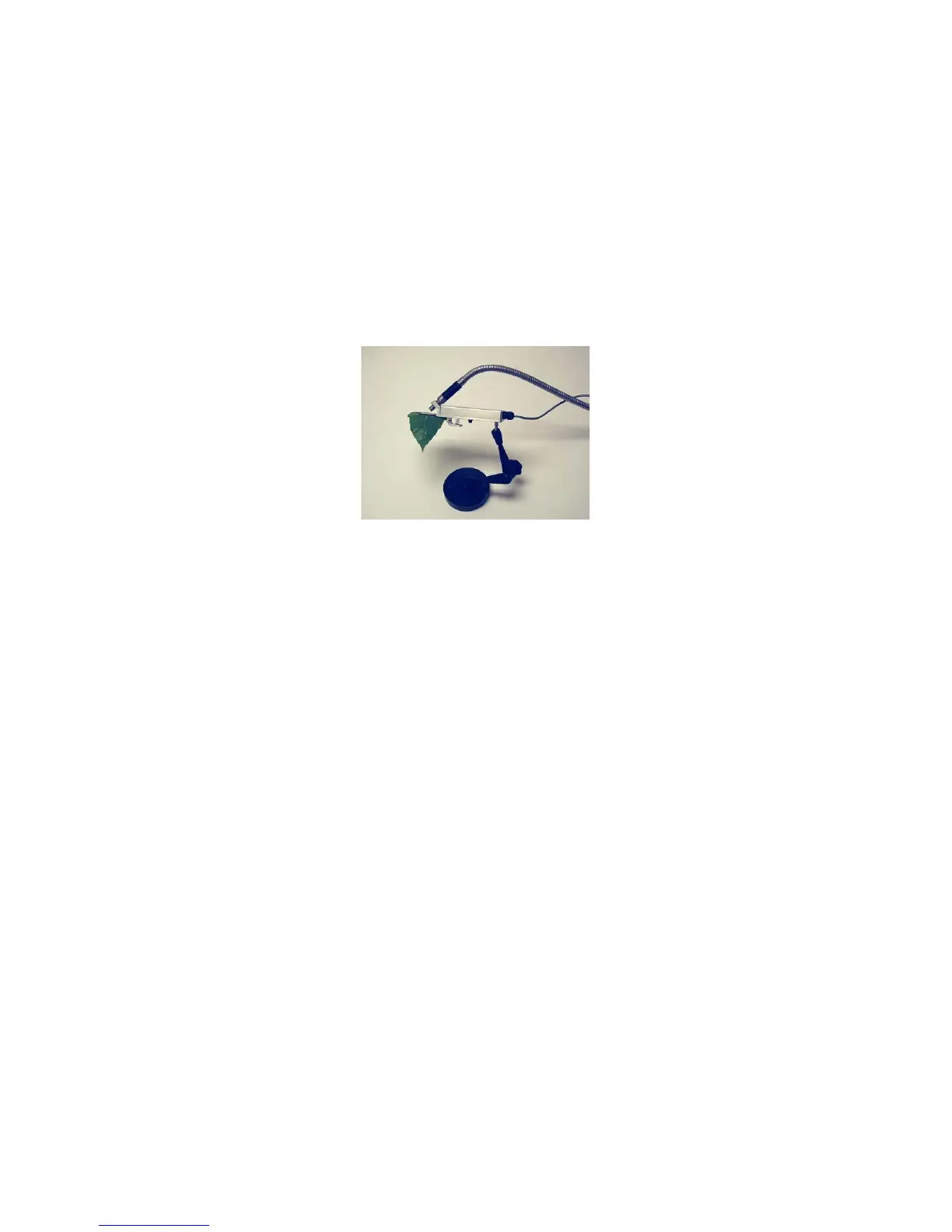
Using the PAR Clip
The PAR clip must be connected to the accessory port on the OS1p when the unit is
turned off.
The PAR Clip will continuously read different light or irradiation values as PAR in the
Y(II) and quenching kinetic tests, as it moves from one light condition to another before a
measurement.
The PAR Clip is designed to measure actinic light intensity and record the average value
just before the saturation pulse, in the Y(II), ETR, and quenching tests. During the
quenching test, it may register up to 3000 uE during the saturation pulse, however, it is
designed to record the actinic value just before the saturation pulse to the measuring file.
When using the PAR Clip, internal actinic light intensities are slightly more that half of
the intensities found when using the dark clips.
When moving from a dark clip to a PAR clip, the modulated light source will require
adjustment in the test protocol that is being used. You may read the “fluorescence value
too low” when the measuring button is pressed. This is because the modulated light
source intensity needs to be adjusted upward. Gain should be adjusted last. The lower the
gain setting, the lower the signal to noise ratio. The modulation light source intensity
should be set with a leaf in the leaf holder of the PAR clip. If it is too low, then the “too
low” message appears during measurement.
The setting can sometimes vary with different samples, for instance, leaves with a low
chlorophyll content may require more modulated light intensity.
When the PAR Clip is used in ambient light, it is important not to change the orientation
of the leaf in relation to the sun or external light source. The leaf has reached steady state


 To Next Page