16
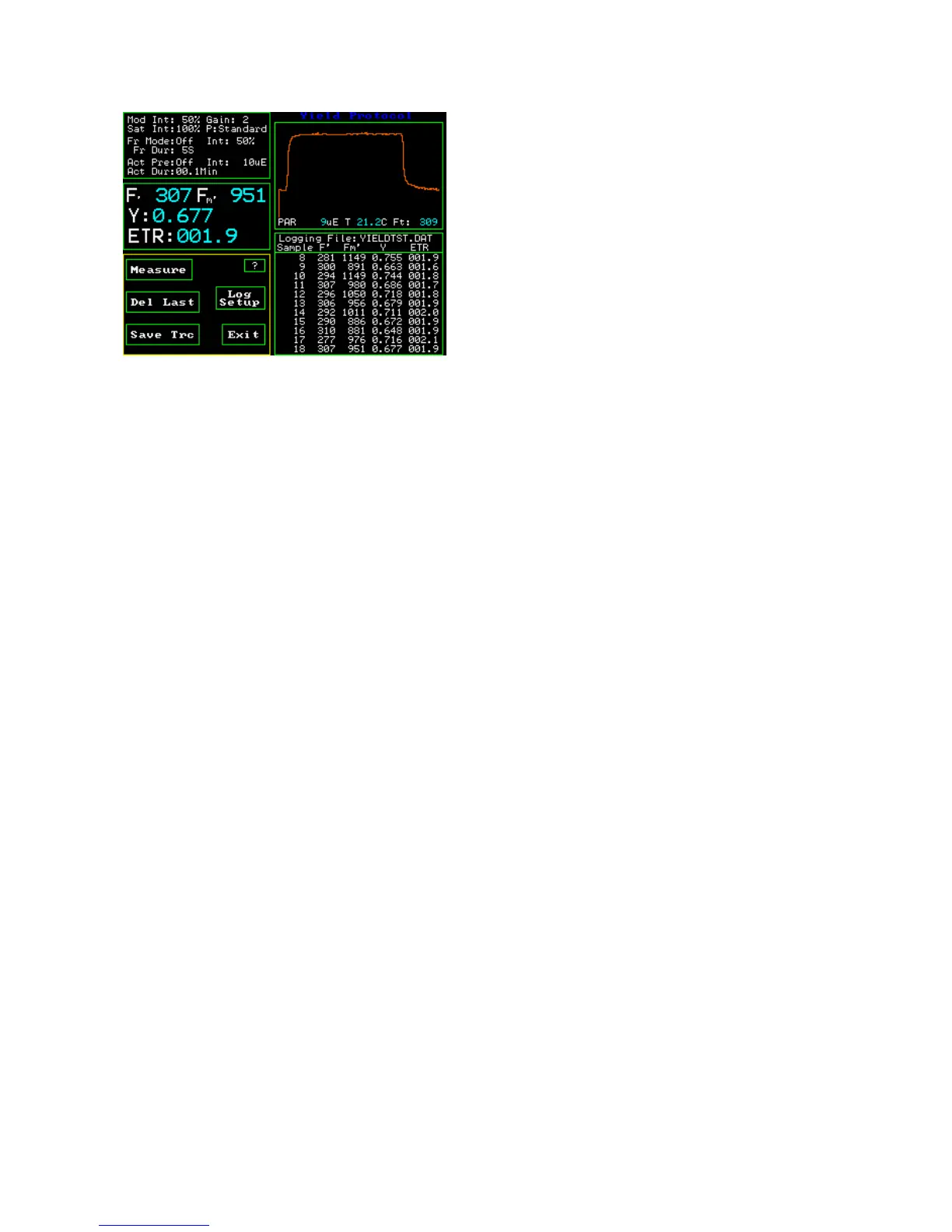
Y(II) or Yield Measuring Screen
Quantum photosynthetic yield of PSII – an in depth
discussion of its value and limitations.
Yield (or )F/Fm’ or (Fm’ – Fs) / Fm’) or Y(II) is a time tested light adapted parameter that is
more sensitive to more types of plant stress than Fv/Fm according to a survey of existing
research. While Fv/Fm is an excellent way to test for some types of stress and the health of
Photosystem II in a dark adapted state, Quantum Photochemical Yield is a test that allows the
measurement of the efficiency of the overall process under actual environmental and
physiological conditions. It has also been found to be more sensitive to more types of plants
stress. See the Plant Stress Guide on this disc or contact Opti-Sciences at www.optisci.com
for details.
Quantum Photochemical Yield of PSII is a normalized measurement ratio that represents
achieved efficiency of photosystem II under current steady-state photosynthetic lighting
conditions. (Genty 1989), (Maxwell K., Johnson G. N. 2000), (Rascher 2000) It is affected by
closure of reaction centers and heat dissipation caused by non-photochemical quenching
(Schreiber 2004).
As ambient light irradiates a leaf, about an average of 84% of the light is absorbed by the
leaf, and an average of 50% of that light is absorbed by the antennae associated with PSII and
transferred to PSII (Photosystem II) reaction centers. (Leaf Absorption can range from 70% to
90% (Eichelman H. 2004) and PSII absorption can range from 40% to 64% (Edwards GE
1993) (Laisk A. 1996)). Under normal non-stressed conditions, most light energy is channeled
into photochemistry with smaller amounts of energy channeled into heat and fluorescence. In
photosystem II, this process is competitive so that as plant stress occurs, mechanisms that
dissipate heat, photo-protect the leaf, and balance light between photosytem II and
photosystem I, change the output of fluorescence and heat. In other words, conditions that
maximize photochemistry minimize fluorescence and heat dissipation and conditions that
maximize fluorescence minimize photochemistry and heat dissipation.



 To Next Page