56
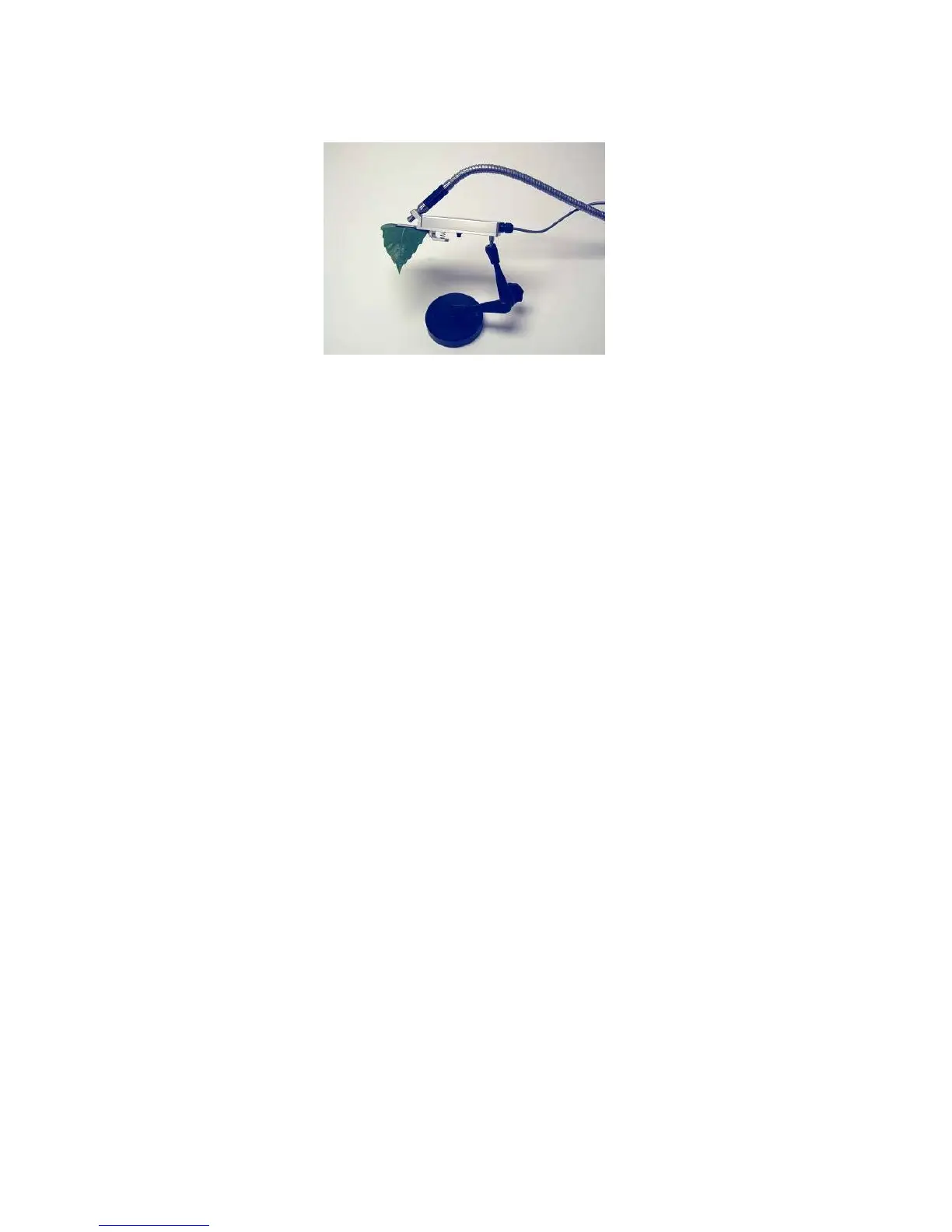
Picture of optional PAR Clip on articulating arm stand
This picture shows the correct placement of the fiber optic bundle on the PAR Clip. The fiber
bundle should be moved in as close as possible to the leaf. PAR Clips are highly
recommended for field light adapted use. Y(II) varies not only with plant stress but also with
light level. Only samples at the same light level and with the same light history should be
compared. Sun leaves respond differently to light levels than shade leaves.
Hardware Overview and Measurement Principles
The OS1p is a portable pulse modulated chlorophyll fluorescence fluorometer It is completely
self-contained, eliminating the need for any external hardware or computing device (palmtop
computer, etc.). All detection and data logging components are on-board.
Fluorescence is measured by a modulated light source in the OS1p. The standard and more
commonly used red modulated source is a diode that peaks at 660 nm with filters blocking
radiation longer than 690 nm. The average intensity of this modulated light is adjustable from
0 to 1 :mol/m
2
/s. It is adjusted to samples so that it does not drive photosynthesis in dark
adapted tests. The source output is optically monitored inside its assembly to correct for
variations in output due to changes in ambient temperature. The optional, less commonly
used, blue modulated diode peaks at 450nm and can be used for algae work or for work with
higher plants as well. Detection is done in the 700 to 750 nm range using a sensitive PIN
silicon photodiode with appropriate filtering to narrow the optical response. A low-noise
preamplifier is mounted in the detector assembly as well. The detection method is a modified
lock-in amplifier design which allows the use of a very low average modulated light energy.
It is the modulated light source that allows actual measurement of Fo, and Fo’ as well at the
measurement of light adapted quantum photosynthetic yield. The gain control is adjustable for
optimum signal to noise ratio. The capture rate is automatically set for the test that is selected.
An added benefit of this system is its ability to disregard extraneous ambient light.


 To Next Page