17
Once these mechanisms have achieved an equilibrium at a specific light level and
temperature, steady state photosynthesis has been achieved. This is a process that takes fifteen
to twenty minutes (Maxwell and Johnson 2000). Once at steady state photosynthesis, a very
intense short light pulse, called a saturation pulse, is used to momentarily close or chemically
reduce all capable PSII reaction centers. Apart from the known exceptions listed under
“Correlation to Carbon Assimilation” later in this discussion, quantum photochemical yield
will reflect changes in the function levels of PSII antennae, PSII reaction centers, electron
transport, carbon assimilation, and regulatory feedback mechanisms.
Y(II) = (Fm’- Fs) / Fm’
Quantum photosynthetic yield is measured only at steady state photosynthesis. Fs is the
fluorescence level at steady state photosynthesis, and Fm’ maximum fluorescence value
measured during a saturation pulse, and is taken to mean that all PSII reaction centers are
closed. In a high light environment, this may not be true and the multi-flash method may be
required. See the multi-flash section for more details.
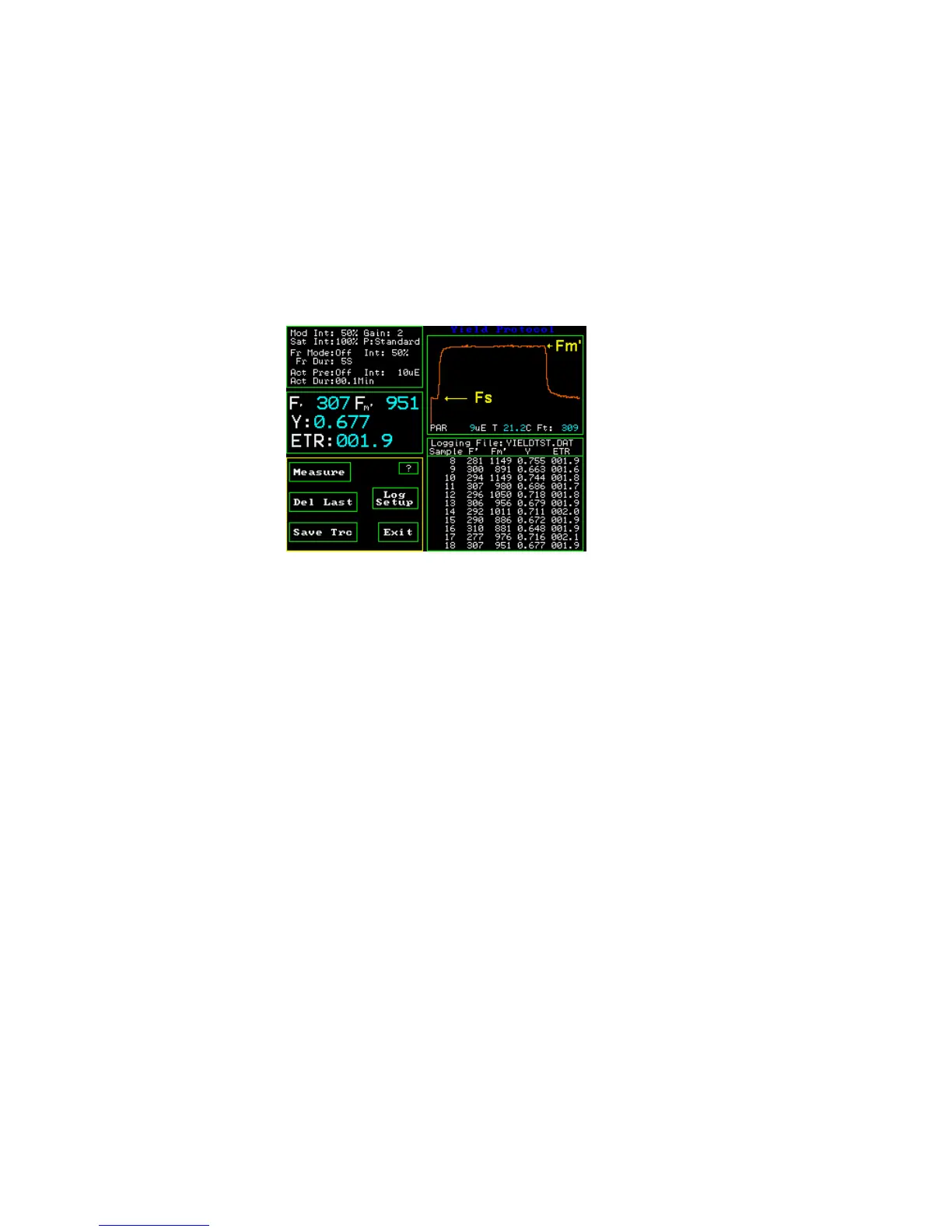
Graphic display of a single Yield measurement taken with a PAR Clip. Yield measurements
may also be taken with an Open Body Clip (without PAR or temperature measurement).
Yield Y(II) will change at different light levels and temperatures so it can be of great value to
use a heavily recommended accessory called a PAR Clip that measures Y(II) relative to light
intensity, or irradiation level, and temperature. PAR Clips measure Photosynthetically Active
Radiation between the wavelengths of 400 nm and 700nm. When the dimensions per square
meter per second in micro-mols or micro-einsteins are added, this parameter becomes
Photosynthetic Photon Flux Density (or PPFD) (micromoles and micro-einsteins are
equivalent, and when using a PAR Clip, PAR and PPFD are equivalent).


 To Next Page