38
The absolute amounts for leaf and PSII light absorption can vary at steady state with species,
and water content. Terrestrial leaf absorbance has been found to vary between 70% to 90%
(Eichelman H., Oja V., Rasulov B., Padu E., Bichele I., Pettai H., Niinemets O., Laisk A.
2004), and the percentage of light absorbed by PSII has been found to range from 40% to
60% (Laisk A. and Loreto F. 1996), (Edwards GE and Baker NR 1993). (quantum yield of
PSII) (measured photosynthetically active radiation measured in :mols.) (leaf absorption
coefficient) (fraction of absorbed light by PSII antennae).
Relative electron transport rate provides an estimate of CO
2
assimilation under most stress
conditions. C
4
plants have been found to correlate in a linear manner with CO
2
assimilation.
(Genty 1989, 1990). In C
3
plants, Correlation with CO
2
assimilation is curvilinear due to
photorespiration, pseudocyclic electron transport or other electron sinks. (Fryer 1998),(Genty
1990) Under some forms of stress, such as cold stress, and water stress, this relationship can
be diagnostic for these two types of stress in C
3
plants (Fryer 1998).
ETR is provided using average values for leaf absorption and PSII absorption. Even so, ETR
provides highly useful comparative data (U. Schreiber 2004). By plotting ETR vs. PAR,
potential ETR rates at maximal quantum yield, photosynthetic capacity, and ETR rate
limitations at a given radiation level (light intensity) can be determined. When ETR is
graphed vs. PAR at specific leaf temperatures a significant amount of information regarding
photosynthesis is obtained. Note: Four electrons must be transported for every CO
2
molecule
assimilated or O
2
molecule evolved.
Absolute electron transport rate is measured by gas exchange measurements. While linear and
curve linear correlation with CO
2
assimilation is possible, relative ETR does not correlate
exactly because while most of radiation is absorbed in the upper layers and provide
fluorescent information, some radiation does enter lower layers and the information is not
captured in fluorometry. CO
2
and H
2
O gas exchange carbon assimilation includes information
from all layers. (U. Schreiber 2004).
Yield can vary significantly with light level and with temperature. Without controlling
irradiation and temperature it is possible to misinterpret results. In fieldwork, where both light
and temperature can vary, a lower Yield measurement on one plant as compared to another
could be misdiagnosed as stress, when it may only be an increase in irradiation or a change in
temperature on the leaf. When a PAR Clip is used to take Yield measurements, the
combination can be formidable. Only samples at similar light levels should be compared for
plant stress using Y(II).
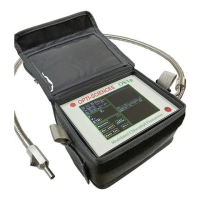
A PAR Clip is a leaf cuvette that allows the holding of the sample leaf at a repeatable angle
and distance from the measuring probe while measuring Yield Y(II), ETR, PAR, and leaf
temperature. These values are contained in same data file with a time and date stamp. PAR
(Photosynthetically Active Radiation) is irradiated light between the wavelengths of 400 nm
and 700nm and it is measured very near the sample measuring area. When PAR is measured
using a PAR Clip and the dimensions per square meter per second are used, the value
becomes PPFD (Photosynthetic Photon Flux Density), (When using a PAR Clip the terms
PAR and PPFD are interchangeable).


 To Next Page