Regulatory Information
Safety Standards & Specifications 10-7
Dropouts
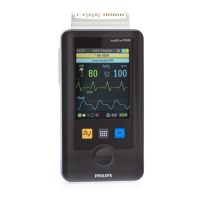
Because the MX40 operates exclusively via a wireless network connection,
under certain frequency conditions dropouts can occur. Dropouts result from
a weak signal or RF interference, and appear on the waveform when the
signal is interrupted. If dropouts are frequent enough to affect the heart rate
count, the "Cannot Analyze ECG" or "Cannot Analyze ST" technical alarm
occurs. If there are enough dropouts to cause disassociation/reassociation
with the Information Center, events in the Clinical Review application can
reflect loss of data for up to 1 minute in the worst case.
Monitoring Considerations
• Patient should be restricted to the designated coverage area. Monitoring
performance will degrade if patients go outside the radius of coverage of
the receiving wireless network.
• A patient location strategy is critical to a telemetry system. If a life-
threatening event occurs, the clinician must be able to locate the patient
quickly. The importance of this increases as the coverage area increases.
• Frequency management is the responsibility of the hospital. Philips
Healthcare has no control over the RF environment in the hospital. If
interference exists at the operating frequencies of the telemetry
equipment, telemetry performance will be affected. Careful selection of
frequencies for all wireless devices used within a facility (transceivers,
other wireless medical devices, etc.) is important to prevent interference
between them.
Caution
IEC/ANSI/AAMI 80001-1:2010
Philips recognizes the importance of a safe and effective network that meets
both the business needs of a healthcare facility, IT networking requirements,
and the clinical functionality. Philips supports the IEC 80001-1 standard in
regards to working as a partner with a healthcare organization in the design,
implementation, and management of the Medical IT-Network to properly
provision and support not only Philips devices, but all the devices using the
network. Applying the principles of risk management to hospital frameworks
is highly encouraged.
When operating the MX40 on a Customer Supplied Clinical Network, Philips
strongly encourages our customers to perform risk management of their
Medical IT-Network infrastructure in accordance with IEC 80001. Changes
may include changes in network configuration, connection of additional
items, disconnection of items, update of equipment, or upgrade of
equipment.


 To Next Page
 Loading...