Frequency Management and Channel Selection
Installation 2-27
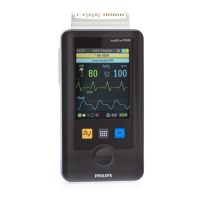
SRR with IntelliVue monitor (Bedside Use Model – WTAAP) – One SRR channel
is configured in the bedside monitor. This is the channel the bedside will use to
communicate with the MX40 and any Cableless Measurement pods. Select the
best channel based on the interference level at the location where the bedside will
be used.
Warning
The Short-range radio operates in the 2.4 GHz band. Short-range radio
connections are subject to interruption due to interference from other radio sources
in the vicinity, including microwaves, Bluetooth devices, and DECT phones.
The most likely interference will come from 802.11b, g wireless LANs.
The 802.11 version of the MX40 may only be used with short-range radio when the
wireless network radio is operating in the 802.11a (5 GHz) band.
In order to reduce the chances of interference, the Short Range Radio channels
should be chosen to operate at frequencies that avoid any 802.11 b/g channels that
are in use in the hospital.
In order to assist with this, recommendations for SRR channels based on possible
802.11 b/g WLAN channel deployments in the 2.4 GHz band are given in the table
below.
For example, if the hospital has an 802.11 deployment using 802.11 channels 1, 6,
and 11, using the table below, short-range radio channels 25, 26, 15, and 20 are
recommended. Using the diagram below as illustration, SRR channel 15 operates
between 802.11 channels 1 and 6, SRR channel 20 operates between 802.11 channels
6 and 11 and SRR channels 25 and 26 operate above 802.11 channel 11, thus
minimizing interference with the WLAN that is deployed.
The table below also lists some short-range radio channels that may be used if a
frequency survey is performed and a power level check is done to ensure that the
frequency is "clear" (has a power level < -80dBm).


 To Next Page
 Loading...