Proxima, Libra firmware ver. 2.12.xx
rev. 2.12.01
The server may handle automatic external calls taking into consideration the lowest
cost of the established connection (LCR service). Thanks to this function, the
server may automatically (according to the LCR table settings) select the trunk
line (operator) to establish a connection.
80xxx access to the line makes it possible to select a specific trunk line. The trunk
line may be selected by dialling *80a*b*c#, where:
a – unit number,
b – slot number,
c – card port number,
e.g. *803*12*4# – trunk line in the third unit, 12th slot on the 4th card port.
4.2.4 Outgoing external calls with CLIR
The server allows outgoing external calls with the presentation of your own
external number manually and intentionally deactivated – CLIR function.
Privileges to use trunk lines are analogous to those applied in the case of outgoing
external calls after dialling “0.”
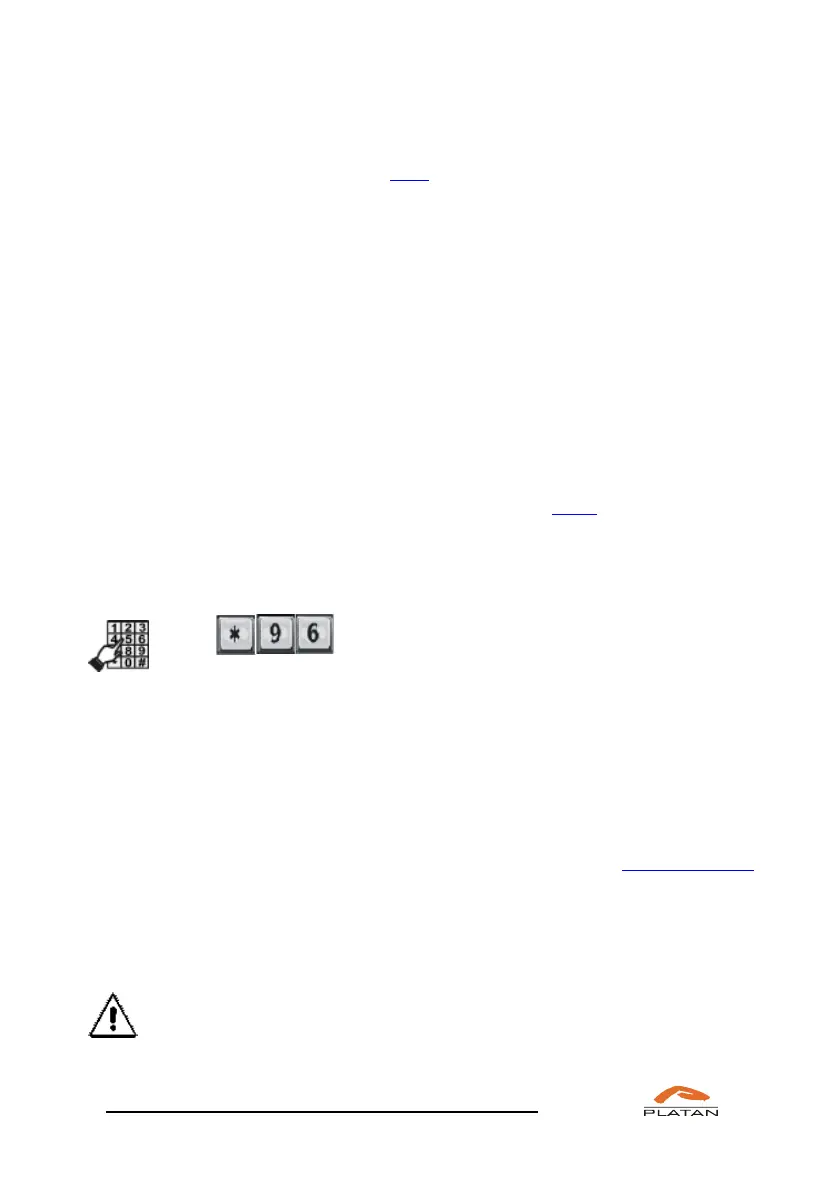
In order to block the calling line identification presentation during an external call:
Dial TEL,
where TEL stands for an external number, e.g. 585558800.
4.2.5 Least Cost Routing – LCR service
LCR service (Least Cost Routing) consists in an automatic analysis of the number
dialled by the user in order to route the call through trunk lines ensuring the
cheapest connection (e.g. depending on the time of the day). This service may
result in changing the first part of the number (prefix) or in changing the whole
number to another, determined in the LCR tables. Next, the right trunk line bunch
is selected, through which the call will be made (provided that the user is
authorised to use this trunk line bunch). Efficiency of the LCR service depends on
the LCR tables’ settings and configuration of users' privileges granted by the
installer.
LCR is employed in processes between the server and the local exchange
with the use of any trunk lines bunch only after a proper configuration in
the computer program.


 To Next Page