882 Video Test Instrument User Guide (Rev A.35) 147
Format library
The generator has a built-in library of formats which are stored as XML files in any of the
generator’s media. This section describes three sets of naming conventions for identifying
formats: 1) Composite television formats, 2) Component television formats, and 3)
Computer display formats. In addition, several miscellaneous naming conventions are
also described.
Composite television format names
Composite television formats apply to RF, D2, CVBS, and S-VIDEO signal interfaces.
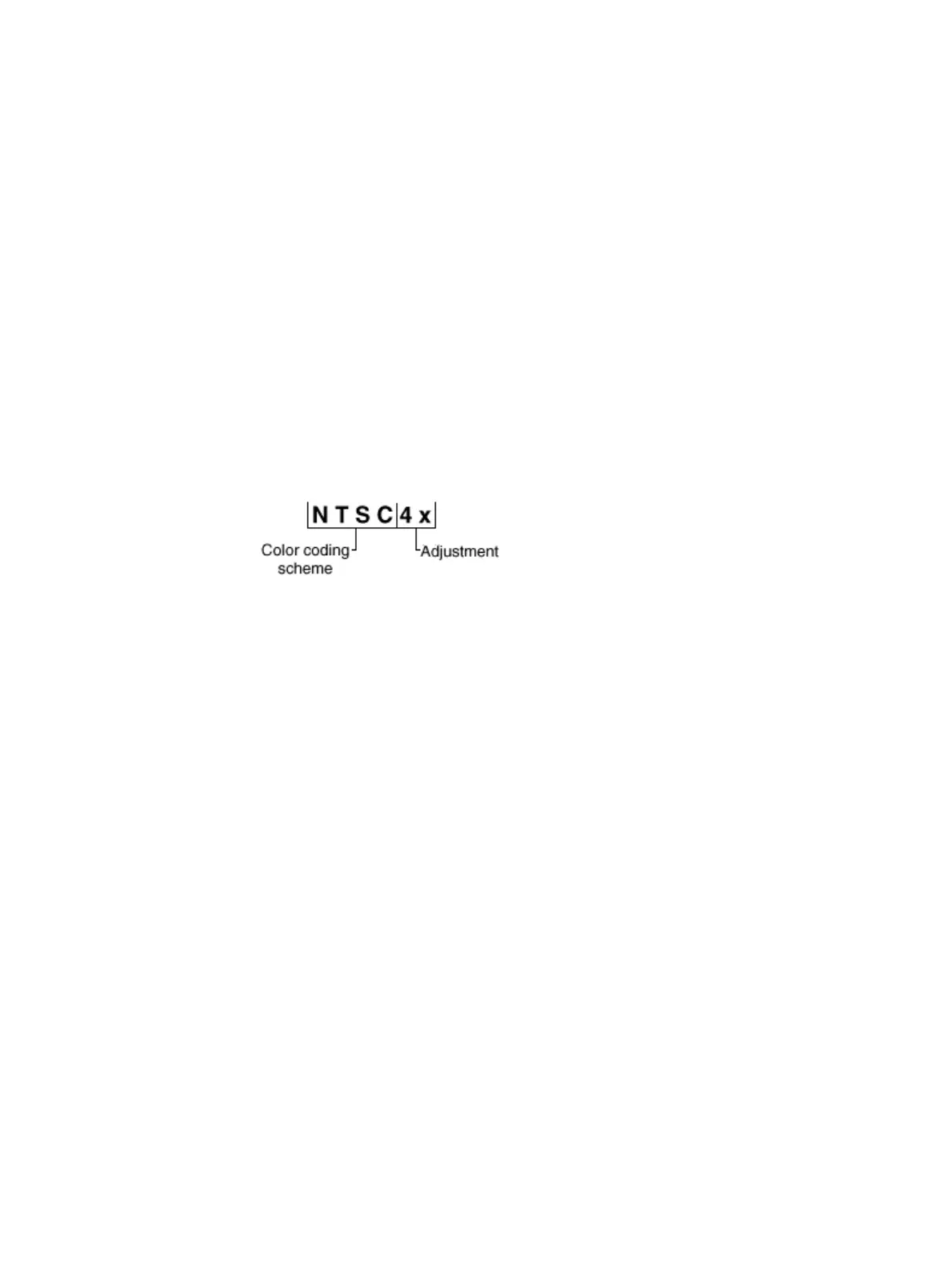
Composite television format names consist of a three to five character color coding
scheme indicator followed by optional characters that indicate format adjustments.
Example
Color coding schemes
•NTSC
•PAL
Adjustments to the format
• 4x == sampling rate is four times the color sub-carrier frequency
• 44 == NTSC with color sub-carrier frequency of 4.43361875 MHz (as opposed to 3.58)
• # == sampling rate is reduced in order to make pixels square
• jp == NTSC-Japan (NTSC without 7.5 IRE setup)
• -M == PAL with 3.57561149 MHz color sub-carrier and M timing (M/PAL Brazil)
• -N == PAL with 3.58205625 MHz color sub-carrier (N/PAL Argentina, Paraguay,
Uruguay)
• -N == NTSC color encoding with N timing (NTSC-N)
• -60 == PAL format that allows NTSC tape playback on PAL TV (PAL-60)
• plusKKKK == Enhanced wide-screen PALplus TV transmission system
• p == progressive video game signal (for example, NTSCp or PALp)


 To Next Page