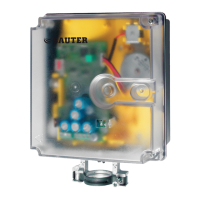
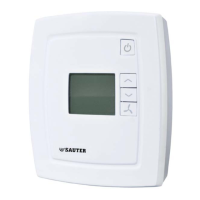
EQJW145:
Heating controller
Operation
7010015003 A
47
© Fr. Sauter AG
4 Operation
4.1 Operating modes
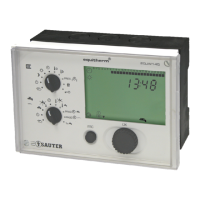
The top rotary switch is used to set the heating circuit. The five left-hand
positions of the top rotary switch (see 2.1 ) enable you to select one of the
following modes:
Manual mode – outputs for pump and valve can be controlled manually
1
)
Back-up mode – heating is switched off, anti-frost monitoring is active unless
parameterised otherwise (see 2.1)
Reduced mode – reduced room temperature (night temperature)
Normal mode
2
– normal room temperature (day temperature)
Automatic mode– controller changes the mode automatically, according to
the weekly and calendar programmes that have been set. Automatic mode
should be selected in normal cases.
The positions of the top rotary switch on the right-hand side allow you to
change the device settings. In these positions, the controller operates in
automatic mode.
Setpoint adjustment - normal mode (day)
Setpoint adjustment - reduced mode (night)
Enter switching programme for heating
Limited temperature change
Commissioning level, service level and communication parameters
contains all the other parameters (heating characteristic, control
parameters, communication settings, etc.).
The bottom rotary switch allows you to set hot water preparation and the pilot
timer. The five left-hand positions of the bottom rotary switch (see 2.1) enable
you to select one of the following modes:
Manual mode – outputs for pump and valve can be controlled manually
3
)
Off mode – hot water preparation switched off, anti-frost monitoring is active
unless parameterised otherwise (see 2.1).
Continuous heating to normal DHW temperature – tank is permanently kept
at normal DHW temperature
1
This is mainly needed for commissioning or in case of faults on the installation.
2
Normal mode corresponds to nominal mode as per EN12098-1.
3
This is mainly needed for commissioning or in case of faults on the installation.



 To Next Page