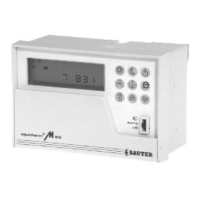
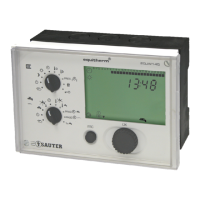
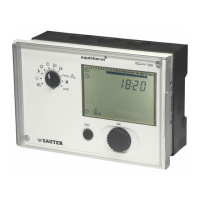
EQJW145:
Heating controller
Faults
7010015003 A
81
© Fr. Sauter AG
The same symbols are used for the control offset or the limit violations that
are also used in the normal display of the measured values (radiators etc.).
By turning the knob, you can change between the display of the recorded
setpoint and the excessively-deviating actual value. If the flow rate is too
high, it is displayed as a percentage.
A repeated fault is entered afresh only if it no longer existed in the meantime.
The logbook can hold a total of 100 entries. When this number has been
reached, the oldest entries are overwritten (circular buffer).
7.3 Reset functions
It is possible to reset the EQJW 145 to the factory setting. To do this, go to
the SERVice level (see section 3.1.1) and set parameter SP04 to:
1 Reset SERVice and communication parameters
2 Reset switching commands
3 Reset SERVice and communication parameters and switching
commands
7.4 Actions to deal with faulty temperature value measurements
The 'Sensor fault' symbol (see 2.1) appears if there is a short-circuit or an
interruption in sensor supply lines. The following list states how the controller
behaves if individual sensors fail.
If the outdoor sensor is faulty, a flow temperature setpoint of 50°C is
operated, or if the maximum flow temperature (set at parameter SP22) is less
than 50°C, the maximum flow temperature is operated.
If the flow temperature sensor is faulty, the valve assumes the 30% valve
position.
If the return temperature sensor is faulty, the controller operates as if no
return temperature sensor were present.
If the room sensor fails, the controller operates according to the settings for
operation without a room sensor.
If the domestic hot water tank sensor is faulty, no further DWH heating will be
performed.
If the 2nd DHW tank sensor is faulty, no further tank charging is performed.
Sensor failure T
A
Sensor failure T
F
Sensor failure
T
RF
,T
RF2
Sensor failure T
R
Sensor failure T
W1
Sensor failure T
W2



 To Next Page