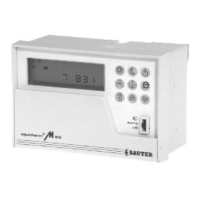
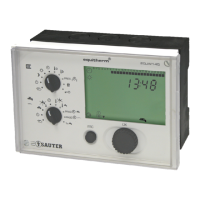
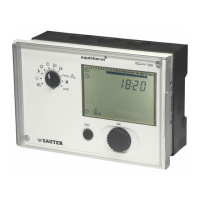
EQJW145:
Heating controller
Communication
functions
68 7010015003 A
© Fr. Sauter AG
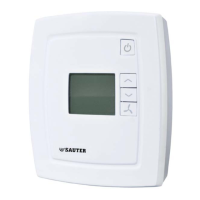
6.2.2 Room operating unit EDB 100
Using the EDB 100 room operating unit, the setpoint temperatures can be
adjusted, various measured values can be interrogated and the mode can be
switched over. These functions can be carried out from the living room. To
connect room operating unit EDB 100 to the EQJW 145 the two device bus
terminals of the room operating unit must be connected to terminals Data1
and Data2 of the controller. The polarity is irrelevant here. The room
operating unit needs a power supply of its own.
On the EQJW 145, parameter CP18 must be set to '1' so that the room
operating unit can be used. The address of the room operating unit must be
set at parameter CP19.
6.2.3 Sending and receiving outdoor temperatures
Controllers which have an outdoor temperature sensor can be configured so
that they make the measured outdoor temperature value available to other
controllers via the device bus. This allows weather-compensated control
even in installations with no outdoor temperature sensors of their own.
To send an outdoor temperature, set parameter CP10 to '1' and to receive
one, set parameter CP11 to '1'.
6.2.4 Requesting and processing a heat requirement
One or more controllers can be connected downstream in a controller
grouping. You can use parameter CP12 to send the required flow
temperatures for the various downstream control circuits to the controller for
the primary circuit. If CP13 is set to '1' on the controller for the primary circuit,
these data will be received. The controller will then control the highest flow
temperature sent to it in the primary circuit.
6.2.5 Requesting and processing a return temperature
Parameter CP14 can be used to measure the current return temperature
(T
RF
) of a controller and to send it to other controllers. On the controllers that
should receive the data, CP15 is set to '1'.
6.2.6 Synchronising the time
If several controllers are interconnected, their times should be synchronised.
For this purpose, CP09 is set to '1' on one of the controllers. Then, this
controller sends its system time to the device bus once every 24 hours. This
time is adopted by the other controllers. Regardless of the setting for
communication parameter CP09, if the time is adjusted on one of the
interconnected controllers, it will be adopted by the others.



 To Next Page