
 Need help?
Do you have a question about the Shimadzu GCMS-QP2010 and is the answer not in the manual?
Confirms the installation conditions and power supply requirements for the GCMS instrument.
Details the unpacking of instrument boxes, assembly on a desk, and wiring connections.
Describes the sequence for turning on instrument power supplies and setting up software environment.
Covers procedures for checking air leaks and performing automatic tuning of the instrument.
Explains the process of auto-tuning, its importance before analyses, and conditions for execution.
Guides on performing qualitative analysis using a standard sample and explains related software functions.
Details the method for quantitative analysis using SIM mode with a standard sample.
Outlines the procedure for measuring Signal-to-Noise (S/N) ratios in EI MODE.
Describes continuous analysis, report generation, and Quality Assurance/Quality Control functions.
Provides a schedule and guidelines for instrument maintenance procedures.
Details the procedure for measuring S/N ratios in CI MODE, including measurement conditions.
Outlines the procedure for measuring S/N ratios in NCI MODE, including specific measurement conditions.
Describes measurements for checking mass patterns in DI MODE, specifying conditions.
Explains how to use MS Navigator for daily maintenance guidance and procedures.
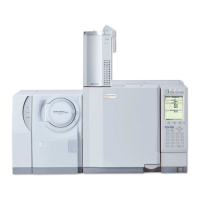
Illustrates the instrument's components and their configuration with part numbers.
Details the procedure for removing and mounting the lens unit, including its components.
Describes the components of the interface unit and their part numbers.
Details the components of the valve system, including standard sample inlet and leak valves.
Explains the MS filter unit, its removal procedure, and pre-rod maintenance.
Describes the detector unit components, connections, and checks during installation.
Details the turbo molecular pumps, their connection, and the procedure for removing them.
Outlines the main power unit and its components, with a caution for electrical safety.
Details the components of the GC unit, including the injector (INJ) and related parts.
Provides a step-by-step guide for updating the instrument's Flash ROM.
Explains procedures for backing up and restoring E2PROM contents for instrument parameters.
Details the pre-adjustment and adjustment procedures for the RF Power Supply Assembly.
Troubleshooting steps for when the MS unit fails to power on, checking power supply and switches.
Guides on interpreting abnormal status LEDs during instrument startup and potential causes.
Troubleshooting steps for establishing MS connection with the PC, checking power and drivers.
Steps to diagnose issues preventing connection between the MS and GC units.
Troubleshooting for failure to reach 'ready' status after automatic startup, checking GC settings and leaks.
Diagnosing issues with Pirani gauge, IC value, and IG not lighting, checking flow rates and piping.
Identifying the source of loud noise from the instrument, checking RP and TMP units.
Troubleshooting steps for obtaining no or very small peaks, checking tuning files and voltages.
Diagnosing issues with ion source temperature control, checking heater switch and parameters.
Troubleshooting specific error codes related to filament operation and power supply issues.
Presents the overall wiring diagram for the GCMS-QP2010 system.
Provides a detailed wiring diagram specifically for the MAIN POWER ASSY.
Offers a detailed wiring diagram illustrating the connections between various PCBs.
Details the operation check method for the MAIN POWER ASSY, including voltage checks.
Explains the operation check method for the DC POWER-A PCB, including voltage checks.
Details operation checks for the MAIN CTRL-A PCB, including supply and lens voltage checks.
Describes operation checks for the IS CTRL-A PCB, focusing on filament and temperature control.
Details operation checks for the HV PCB ASSY, covering high voltage and discharge confirmation.
Explains installation checks and voltage verification for the IG CTRL-A PCB.
Details supply voltage checks and operation confirmation for the CPU-A PCB.
Describes operation checks for the RF PS ASSY, including supply voltage and tuning checks.
Explains operation checks for the DI CTRL-A PCB, focusing on power and heater voltage.
Details operation checks for the RELAY BOX-A, including power supply and RP2 control.
Lists general precautions for maintenance tasks, including CPU-A, RF PS Assy, and pump replacements.
Provides a procedure for manual calibration in the high mass-number range using a triazine sample.
Explains the differences and specifications for CI and NCI ionization modes.
Summarizes preparations for smooth installation, ensuring safety and reliable analysis.
Specifies environmental requirements for the installation room, including temperature and humidity.
Lists the power supply requirements for each instrument unit, including voltage and capacity.
Details requirements for reagent gases (CI/NCI) and carrier gas (Helium), including purity and pressure.
Specifies requirements for exhaust ducting or oil-mist filters for safe instrument operation.
Lists additional required items for instrument installation and evaluation.
A checklist summarizing installation conditions for customer completion and submission.
 General
| Software | GCMSsolution |
|---|---|
| Ion Source | Electron Ionization (EI) |
| Scan Speed | 10, 000 amu/sec |
| Data Acquisition | SIM/Scan |
| Resolution | Unit mass resolution |
| Ion Source Temperature | Up to 300°C |
| Interface Temperature | Up to 350°C |
| GC Compatibility | Compatible with Shimadzu GC-2010 series |
| Detector | Quadrupole |
| Vacuum System | Turbo molecular pump |
| Sensitivity | 1 pg of Octafluoronaphthalene |




 To Next Page