16 Copyright Silca 2004
IDEA Operating Manual - English
4.2 U
SE
OF
THE
CLAMP
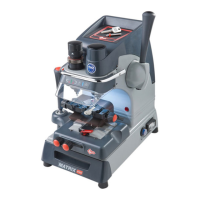
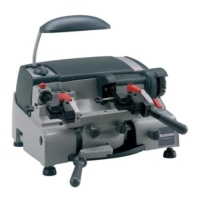
The rotating clamp (S1) (fig. 17) is the fundamental tool of IDEA. It has various functions and constitutes the
third working axis (rotation) controlled by the machine. The rotating clamp is housed in a mobile support
which runs along the X axis (spaces) and is anchored to the carriage below it by means of a dovetail guide;
this allows the operator to position the clamp at any point along the key stem, ensuring the best grip on the
stem.
L
OCKING
The rotating clamp is locked in position by means of the handle (T1) (fig. 17); the position along the X axis
starts from the resting point for the jaws on the tailstock up to a rear mechanical stop which prevents the
mobile support from coming off dovetail support.
R
EMOVAL
Turn off the machine and pull out the plug. If it is necessary to remove the rotating clamp from the guide (for
cleaning, etc.) turn the knob (T1) to release the underlying mechanical stop. Loosen the screw (T2) (fig. 10,
page 8) and pull out the rotating clamp.
After replacing the rotating clamp into the guide, turn the knob (T1) to activate the stop. Tighten the screw
(T2). Before removing the clamp, remember to disconnect the coupling for the rotating clamp connector
extension (B1) from the “Y axis carriage”, then to connect it again when the clamp has been replaced.
G
RIPPERS
The grippers (G1) are opened and closed by means of the countersunk hexagonal screw (V1), activated by
the “T” wrench (T4) housed on the machine.
The grippers (G1) ensure that the key stem is centred on its axis within the set dimensions (min.3.6 mm,
max.7 mm); the mobile jaws adapt to the diameter of both straight and conical stems. The universal tailstock
support (K1) is designed and set to align the rotating clamp along the axis of the key stem parallel to the
movement of the carriage X (spaces), so that it remains flat under the cutter; this ensures perfect
concentricity between the axis and the key stem with any radial position.
F
UNCTIONS
The rotating clamp provides rotation for the keyblank; this serves two main purposes:
1) to provide the cutting radius concentrical to the axis of the key stem during the cutting operation, with a
tolerance of +/- 30°.
2) to turn double bit keys 180°. By means of a PC function, it also provides interpolation of the movements
between the Y axis (depth) and the rotation axis B, enabling “radial cuts with set measurements”.
I
NSERTING
THE
KEY
The rotating clamp makes it possible to insert keys from either the front or the back, according to the length
of the key.
Fig. 17
T1
V1
K1


 To Next Page