20.5 Capacitors
Capacitor test do check the insulation quality of the device. Normally the dissipation factor should be low and
should stay stable as well as the capacitance. Units to be tested are power-factor correction capacitors (cap banks,
used to improve the power factor of a high voltage grid), surge capacitors, energy storage capacitors, etc.
Capacitors can be built based on series of single cap modules (e.g. paper-oil coupling capacitor) If one modules
shows a problem the result is always the average of all connected modules. So a small change in the measured
total value could show a bigger problem in a single module.
Before any measurements are done it must be verified that the capacitor is
completely discharged. Bushings and housing must be earthed.
Measurement Procedure
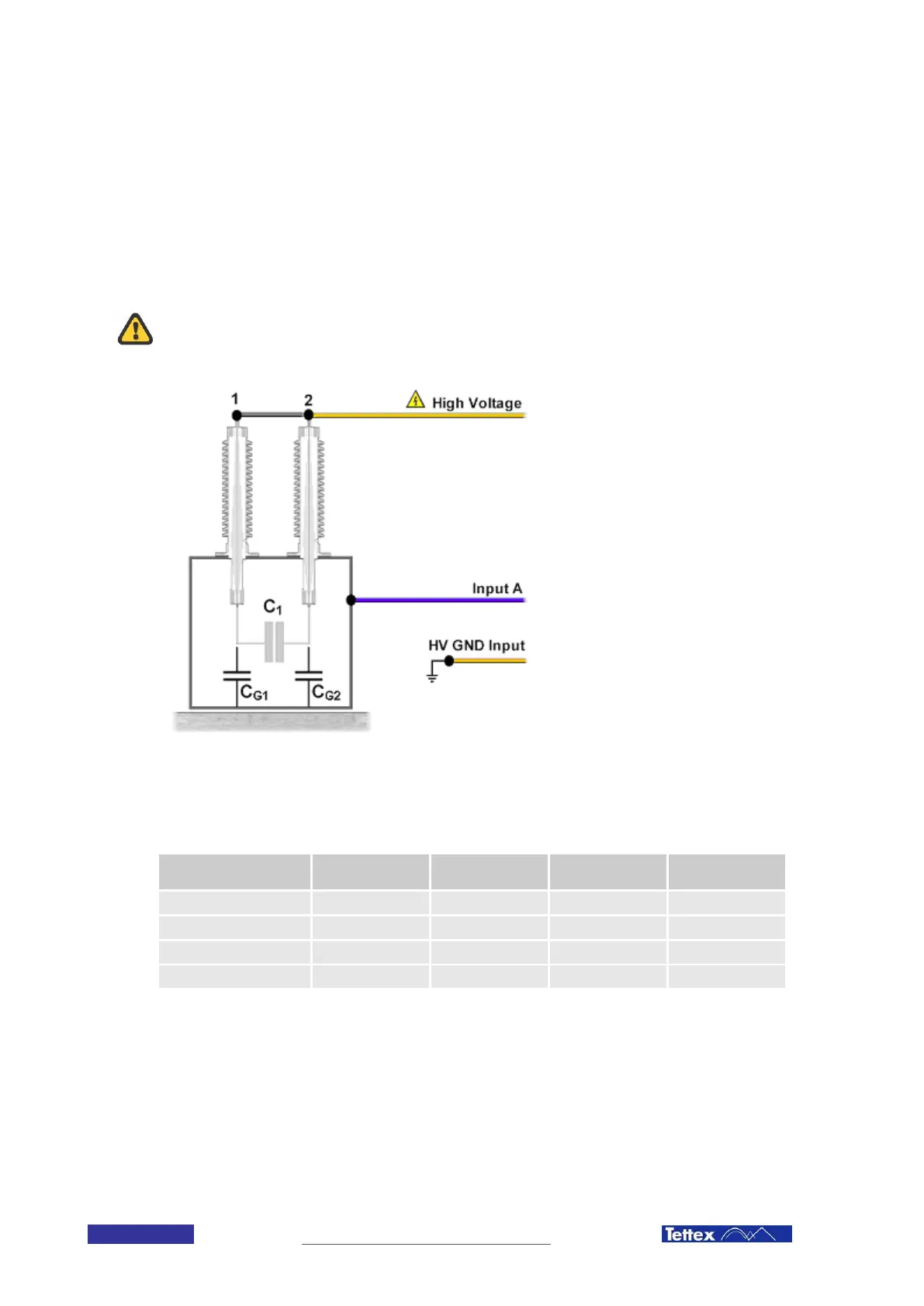
Measurement on an ungrounded two-bushing energy storage capacitor, connection for
determination of C
G1
+ C
G2
C
1
: main capacitor
C
G1
, C
G2
: earth insulation capacitance
Test Connections
DUT
High Voltage
to
INPUT A
to
HV GND
to
Test Mode
G2
20.6 Circuit Breakers
For insulation measuring purposes high voltage circuit breakers can be classified into two groups. Live tank
breakers whose interrupting chamber is on HV potential and dead tank breakers whose interrupter chamber is
accommodated in an earthed metal housing.
The applied test voltage for breakers should not exceed 10% to 25% above their rated operating line-to-ground
voltage. That means in formula:


 To Next Page