An increase of dissipation factor above a typical value may indicate conditions such as those showed above: If the
dissipation factor varies significantly with voltage down to some voltage below which it is substantially constant,
then ionization is indicated. If this extinction voltage is below the operating level, then ionization may progress in
operation with consequent deterioration. Some increase of capacitance (increase in charging current) may also be
observed above the extinction voltage because of the short-circuiting of numerous voids by the ionization process.
An increase of dissipation factor accompanied by a marked increase of the capacitance usually indicates
excessive moisture in the insulation. Increase of dissipation factor alone may be caused by thermal deterioration or
by contamination other than water.
Unless bushing and pothead surfaces, terminal boards, etc., are clean and dry, measured values not necessarily
apply to the insulation under test. Any leakage over terminal surfaces may add to the losses of the insulation itself
and may give a false indication of its condition.
5.7.2 Dissipation Factor of Typical Apparatus Insulation
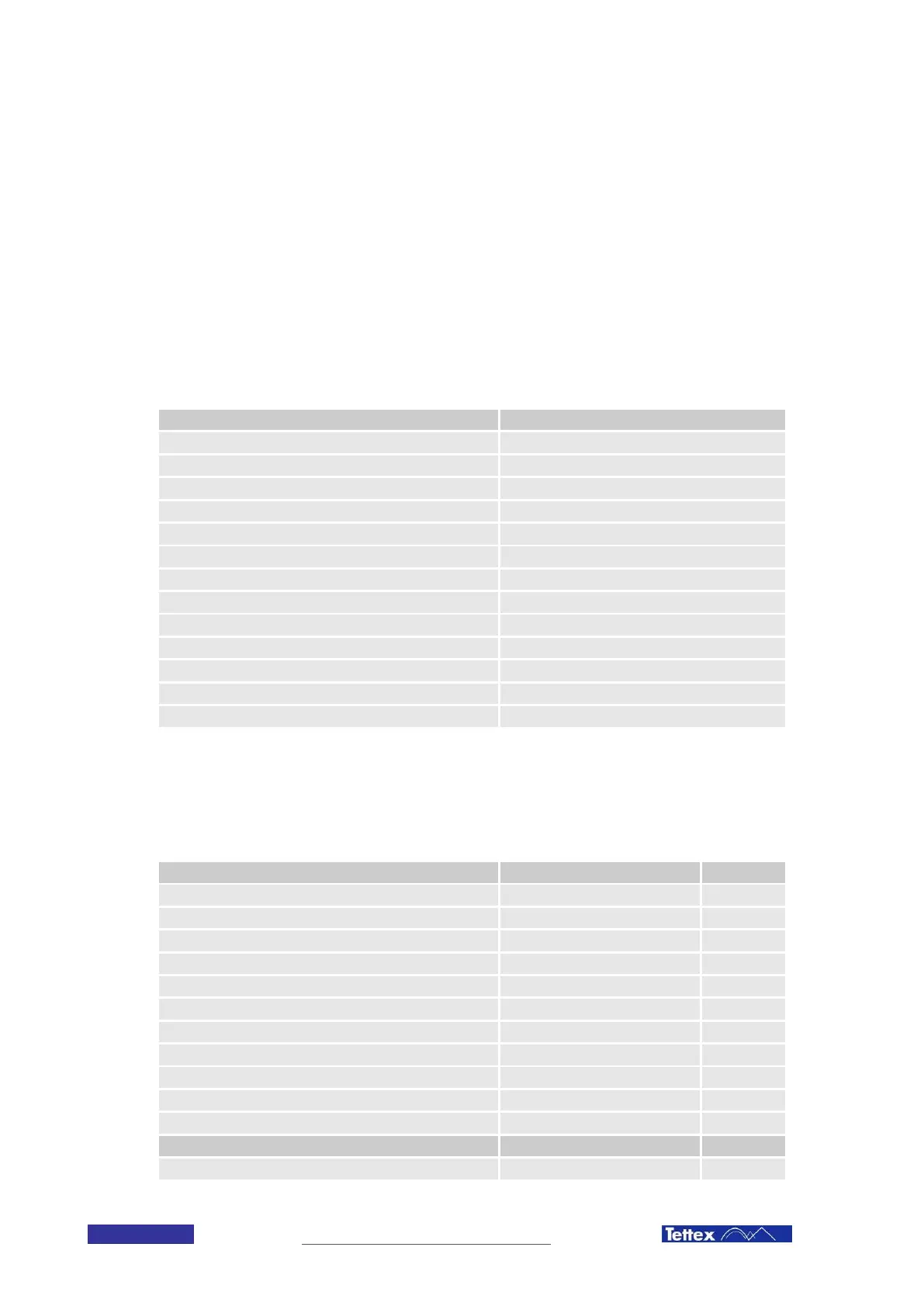
Values of insulation dissipation factor for various apparatus are shown in this table. These values are useful in
roughly indicating the range to be found in practice; however, the upper limits are not reliable service values.
Equipment Dissipation factor @ 20°C
Oil-filled transformer, new, HV ( > 115kV) 0.25% .. 1.0%
Oil-filled transformer, age 15 years, HV ( > 115kV) 0.75% .. 1.5%
Oil-filled transformer, age 15 years, LV, distribution 1.5% .. 5%
Circuit breakers, oil-filled 0.5% .. 2.0%
Oil-paper cables, "solid" (up to 27.6 kV) new 0.5% .. 1.5%
Oil-paper cables, HV, oil-filled or pressurized 0.2% .. 0.5%
Stator windings, 2.3 .. 13.8kV 2.0% .. 8.0%
Capacitors 0.2% .. 0.5%
Bushings, (solid or dry) 3.0% .. 10.0%
Bushings, compound-filled, up to 15kV 5.0% .. 10.0%
Bushings, compound-filled, 15 .. 46kV 2.0% .. 5.0%
Bushings, oil-filled, below 110 kV 1.5% .. 4.0%
Bushings, oil-filled, above 110 kV 0.3% .. 3.0%
5.7.3 Dissipation Factor and Dielectric Constant of Typical
Insulation Materials
Typical values of 50/60Hz dissipation factor and permittivity (dielectric constant ε ) of some typically used insulating
materials.
Material Dissipation factor @ 20°C ε
Acetal resin (Delrin™) 0.5% 3.7
Air 0.0% 1.0
Askarels 0.4% 4.2
Kraft paper, dry 0.6% 2.2
Transformer oil 0.02% 2.2
Polyamide (Nomex™) 1.0% 2.5
Polyester film (Mylar™) 0.3% 3.0
Polyethylene 0.05% 2.3
Polyamide film (Kapton™) 0.3% 3.5
Polypropylene 0.05% 2.2
Porcelain 2.0% 7.0
Material Dissipation factor @ 20°C ε
Rubber 4.0% 3.6


 To Next Page