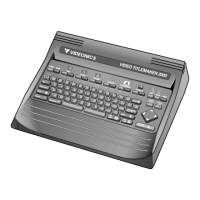
10. POSN (POSITION). Press and release POSN, followed by up or down arrow keys, to
position text at the top, bottom, or center of the page. Press and release POSN, then
left or right arrow, to position text at right, left, or center page. (Chapter 10)
11. TAB. “Smart tab” positions cursor to match spaces in previous line of text. Also used
to choose which submenu is active. (Chapter 6)
12. SHIFT and CAPS LOCK. Hold SHIFT to type capital letters. CAPS LOCK capitalizes all
typing until pressed again. Note that some fonts have only capital letters. SHIFT is also
used to modify the function of other keys. (Chapter 6, Appendix A)
13. CMD (COMMAND). Modifies function of other keys. (Appendix A and Chapter 18)
14. Z (CLOCK). CMD (Command) + Z displays clock menu. Use to set current time dis-
play format, set current time and set internal timed trigger for projects. (Chapter 18)
15. ACCENT. Hold ACCENT while typing a letter key to type the special symbols (•,©,¢,etc.)
printed in blue. Use with power key to activate DEMO. Use with accent marks fol-
lowed by a letter to type accented international characters such as é, ü, å, etc. (Chap-
ter 5 & 6)
16. PLAY. After you create titles using the Editing Screen, press either PLAY key (#16 or
#21) to play the titles for display or recording. CMD (Command) + PLAY always plays
from first page in project. If no text is marked, PLAY displays the next page. If text is
marked, PLAY loops through marked pages. Once playing begins: Press PLAY again to
go to next page; use SHIFT and PLAY to play backwards; press arrow keys to manually
step forward or backwards. NEW LINE/OK ends play and returns to Editing Screen.
(Chapter 20)
17. X (DATE). CMD (Command) + X displays date menu. Use to set current date display
format and set current date. (Chapter 18)
18. SPACE BAR. Adds space to text. Pauses the page that is playing.
19. PAGE INDEX. Displays an index in which each page occupies one line, making it easy
to look through all pages and projects. Projects are created and named using PAGE
INDEX. (Chapter 8)
20. NEW PAGE. Starts a new page of text. CMD (Command) + NEW PAGE starts a new
project when Page Index is on screen. (Chapters 7-8)
21. PLAY. Identical to item 16.
22. ARROW KEYS. Use the four individual arrow keys to move the cursor on screen; to
change highlights in a menu; and, when playing text, to go forward and backward.
SHIFT makes arrow act on one page at a time; CMD (Command) with UP or DOWN
goes to top or bottom of all text. CMD (Command) + SHIFT + UP or DOWN moves
you between projects. (Chapters 6, 11, and 19)
23. PAGE UP and PAGE DOWN. Used to re-position cursor a page at a time. PAGE UP
places cursor at the first line of the page, PAGE DOWN places cursor at the last line in
the page.
24. NEW LINE/OK. Ends a line of text and starts a new one. Also accepts settings of
menus, returns to Editing Screen from Page Index and Play Screens. (Chapter 6)
25. LEFT and RIGHT BRACKET. Use the left and right bracket to change sub-menus.
MARK START, MARK END, and TAB will do the same.


 To Next Page