OPERATION
Axio Vert.A1
Use of LD Objectives Carl Zeiss
05/2012 431030-7044-001 71
4 OPERATION
4.1 Use of LD Objectives
In tests performed with inverted microscopes,
vessels are usually employed whose bottom
thickness differs considerably from the common
cover slip thickness of 0.17 mm.
Normally, the working distances (a) of low-
magnification objectives easily bridge such
distances.
− A-Plan 5x / 0.12 a = 10.9 mm (in air)
or
− A-Plan 5x / 0.25 a = 5.3 mm (in air)
When it comes to the medium magnification
range, however, those working distances shrink to
values around or below 1 mm in most cases. Those
objectives can than no longer be utilized for
greater bottom thicknesses.
This deficiency can be overcome with special LD (long-distance) objectives. They feature a relatively long
working distance as well as the usual 45-mm parfocal length of all the other objectives.
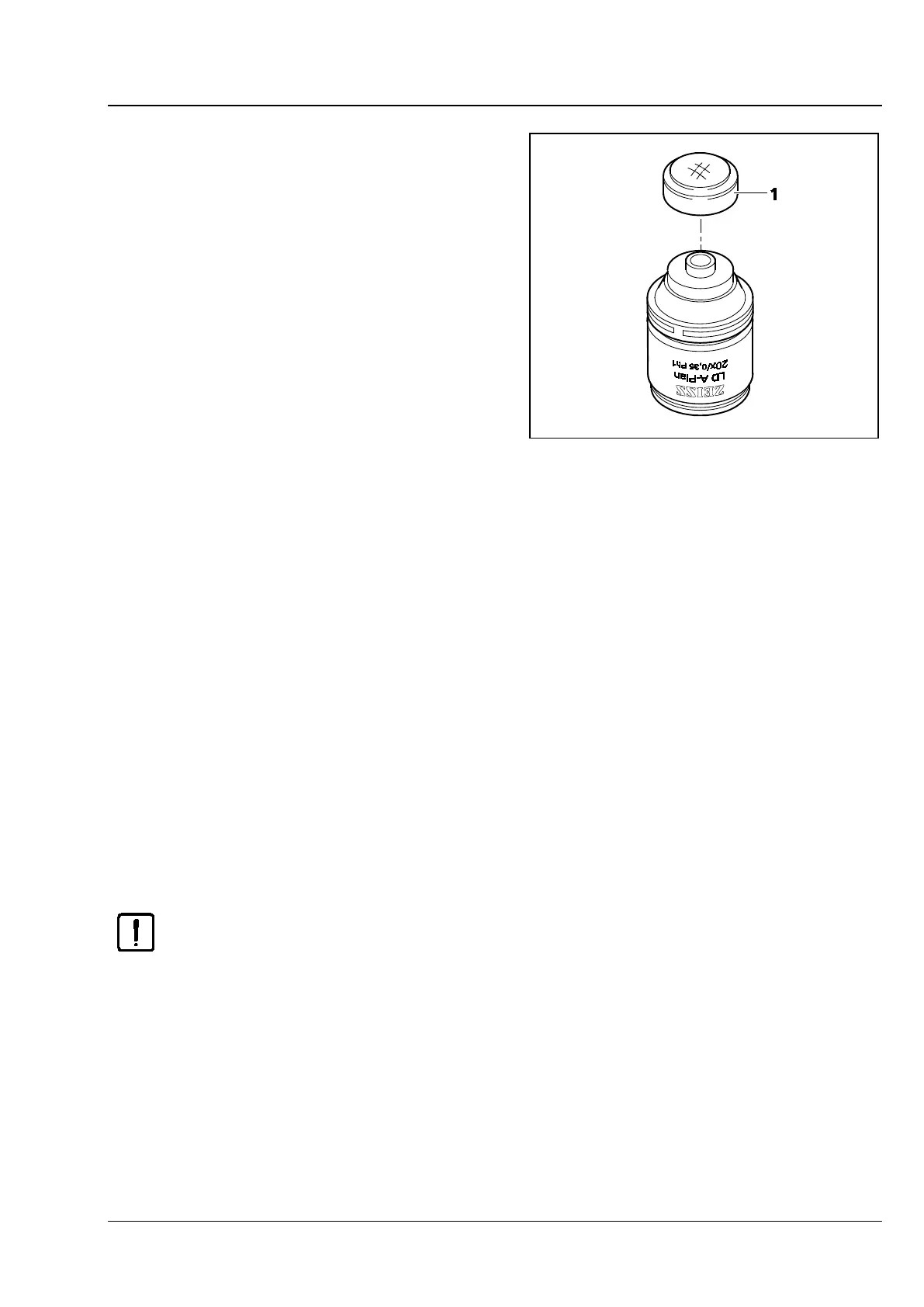
Plug the appropriate cover slip cap (Fig. 3-37/1) onto the objective to adapt LD A-Plan objectives to thin
bottoms or cover slips.
4.2 Use of Korr Objectives
For an excellent image, the correct cover slip thickness is important.
It is for this reason that Korr objectives can be adjusted to cover slips of different thicknesses through a
correction mount. To this end, select an area of the specimen and determine the position of the
correction mount where image sharpness and image contrast are best. (It will always be necessary to
readjust sharpness.)
CAUTION
Make sure that the specimen plane is not more than 2.5 mm above the surface of the stage
to prevent the LD Korr objective from hitting the underside of the stage. Specimens on a
1-mm thick vessel bottom can be focused if the vessel is moved by the object guide
and the
mounting frame. In this condition, it is possible to rotate through all the objectives on the
specimen stage without collision.
Fig. 3-37 Working with LD Objectives



 To Next Page