OPERATION
Axio Vert.A1
Illumination and Contrast Techniques in Transmitted Light Carl Zeiss
05/2012 431030-7044-001 85
Aligning the iHMC Module
• Rotate the iHMC objective into the light path.
• Put on the microscope a typical specimen, such as an egg cell or adherent cells, placed in a cultivation
dish.
• View and focus the specimen via the eyepieces.
• Replace an eyepiece by inserting the auxiliary microscope into an eyepiece tube.
The rear focal plane of the objective will now be visible through the auxiliary microscope.
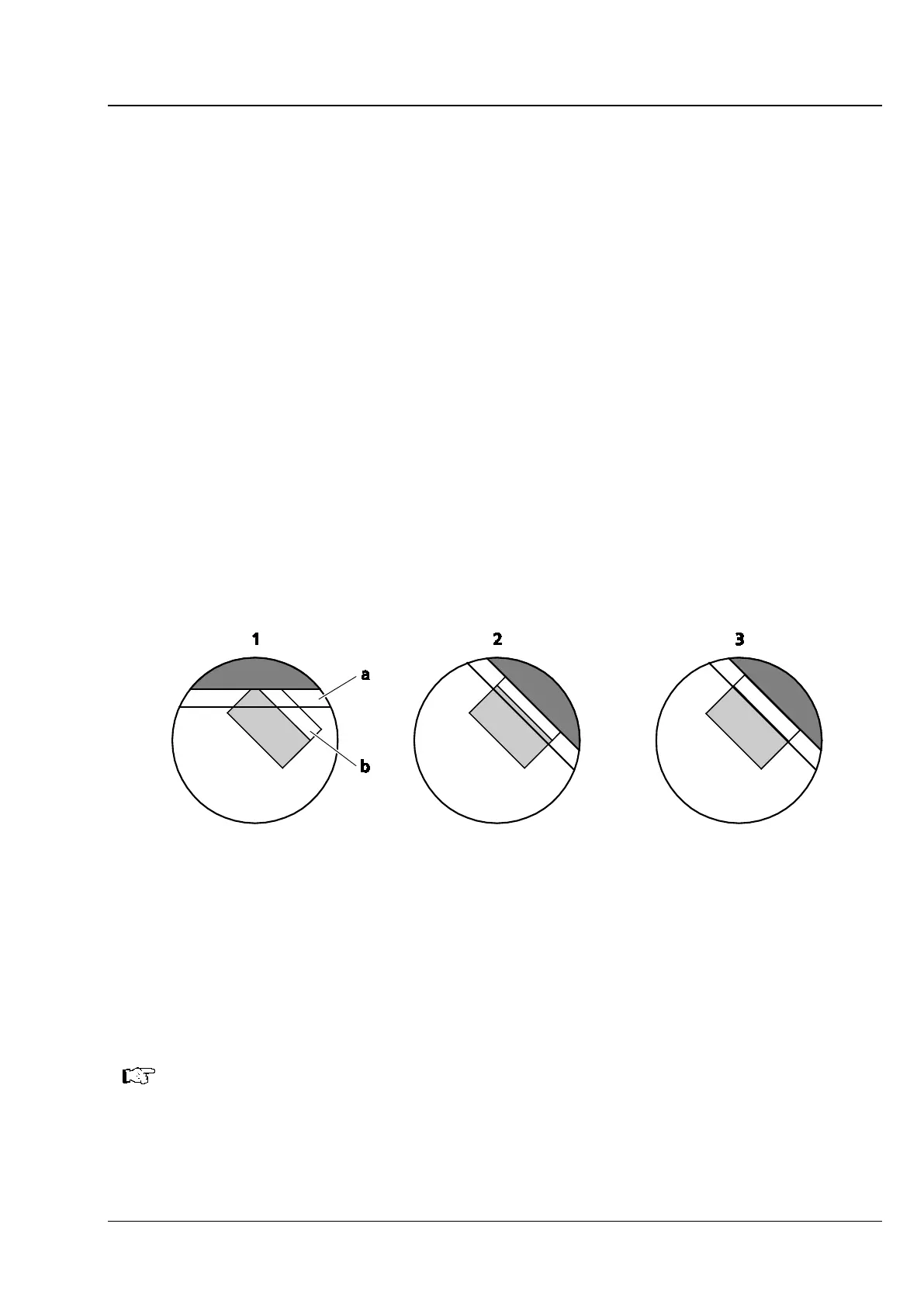
• Adjust the eye lens of the auxiliary microscope to bring the zone plate of the objective (Fig. 4-11/1a)
and the iHMC diaphragm (Fig. 4-11/1b) in focus.
• Turn the ring of the iHMC objective until the zone plate is aligned parallel to iHMC diaphragm. (See
Fig. 4-11/2.)
• Using the two centering keys, move the iHMC diaphragm until area a of the zone plate and area b of
the iHMC diaphragm line up completely in middle position if possible (Fig. 4-11/3). In the example
shown, the position of the contrast elements may appear rotated in relation to Fig. 4-11, depending
on the relief impression orientation chosen.
• Remove the auxiliary microscope and insert the eyepiece.
• Stick onto the relevant space for the condenser position used the condenser label for the iHMC
magnification just set. (The numbers of the space at the front and of the condenser position set must
be identical.)
Fig. 4-11 Aligning of the Objective Zone Plate and the iHM Diaphragm
Operation during Experiments
• Put on the specimen and view it through the eyepieces.
• Insert the polarization slider (D 10 mm x 46 mm, rotatable 90 degrees) into the condenser.
• Fine adjust the contrast on the polarization slider (D 10 mm x 46 mm, rotatable 90 degrees).
The contrast will be lost if the objective ring is turned inadvertently during the operation of
the microscope. If this happens, repeat the steps described to reestablish the contrast.



 To Next Page