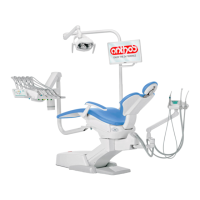
A3 PLUS - A5 - A6 PLUS - L6
SURGICAL SINGLE CART
1.6. STERILISATION
Every instrument supplied is NOT STERILE and must be sterilized in steam autoclave (max. 135°C) before use, without performing any type of chemical
sterilization.
Sterilization must be performed using appropriate packaging materials, verified during the sterilization process validation.
It is recommended to sterilize in steam autoclave (moist heat) through a cycle with pre-vacuum (forced air removal).
Autoclaves must comply with and be approved and maintained in accordance with the requirements set forth by the Standards EN 13060 (or
ANSI/AAMI ST55), EN ISO 17665-1 and ANSI/AAMI ST79.
Below are the minimum recommended parameters for the sterilization of reusable medical devices, that have been approved in order to ensure a
sterility assurance level (SAL) equal to 10^-6:
• Cycle type: with pre-vacuum (Pre-vac).
• Method: "overkill" moist heat sterilization according to Standard ISO 17665-1.
• Minimum temperature: 134° C (273° F) for heat-resistant materials (instruments and metal handpieces, etc.);121°C (250°F) for thermolabile
materials (rubber items, etc.).
• Minimum exposure time (1): 4 minutes (at 134°C), 20 minutes (at 120°C).
• Minimum drying time (2): defined to ensure compliance with the requirements of Standard EN 13060 (or ANSI/AAMI ST55).
1 Exposure time: time during which the load and the entire chamber are kept at a temperature higher than the sterilization one.
2 Drying time: time during which steam is removed from the chamber and the chamber pressure decreases to allow the condensate to evaporate from
the load through a prolonged emptying or thanks to the supply of hot air or other gases then removed.
The drying time varies according to the load configuration and the packaging type and material.
1.7. NETWORK AND DATA SECURITY
The dental unit includes a Wi-Fi module, an optional Ethernet connection that allows connecting to the local network and useful services, including
device troubleshooting section and firmware updates.
The Wi-Fi module supports IEEE 802.11 b, g, n with WEP, WPA, WPA2-PSK encryption standards at a frequency of 2.4 Ghz.
Since the security of the connection depends on the configuration of the wireless infrastructure (router or access point), securing Wi-Fi® connections is
an important aspect in protecting data.
Avoid placing devices connected to the network in places that are publicly accessible without surveillance.
When using USB pendrives to download images, make sure that the data are copied to a disk that is backed up regularly.
Certain precautions regarding network security are recommended:
• If the network is configured for an older generation security setting (WEP or WPA), consider upgrading to WPA2 as soon as possible.
• Select an effective network passphrase. In general, increasing the length, complexity and randomness improves the quality of a passphrase. A
passphrase should not contain a word found in a dictionary and should not include personal information (identification number, name, address, etc.).
• Periodically changing the passphrase on the network also increases security.
• Verify the correct management of user access and logs on the infrastructure (PCs, devices, etc.).
• Verify that a firewall is enabled and configured correctly.
1.8. AUTHORISED AGENTS


 To Next Page