1.3. SAFETY WARNINGS
• All equipment is permanently installed.
Depending on the type of dental chair the dental unit comes with, refer to the installation SCHEMATICS in paragraph DATA
SPECIFICATIONS
The CEFLA s.c. shall not be held liable for any personal injury or property damage arising from failure to heed the following clause.
• Floor conditions.
The floor (continuous) should meet the load-bearing capacity set forth by DIN 1055, sheet 3.
The weight of the dental unit including a patient is about 400 kg.
For further details on anchoring conditions, refer to the Installation Manual.
The positions of delivery and drain line connections comply with standard ISO 7494-2.
In case of floor installation without load distribution plate, floor characteristics must ensure a breaking strength of the anchor bolt not less than
1200 daN each (considering RcK concrete strength 20 MPa). In case of floor installation with load reduction plate, floor characteristics must
ensure a strength of the anchor bolt not less than 260 daN.
• This device may not be modified in any way without the authorisation of the manufacturer.
If the device is modified, appropriate examinations and tests need to be conducted in order to ensure continued safe use.
The CEFLA s.c. shall not be held liable for any personal injury or property damage arising from failure to heed the following clause.
• Dental chair.
The maximum load values indicated in the DATA SPECIFICATIONS paragraph must never be exceeded.
• Tray holders.
The maximum weights that can be held must never be exceeded:
- tray holder attached to the dentist's board, maximum permitted load on the tray holder module 2 kg, evenly distributed.
- Tray holder attached to the assistant's board, maximum permitted load 1 Kg, evenly distributed.
- Auxiliary tray holder, maximum permitted load on the tray 3.5 Kg (without negatoscope) or 2.5 Kg (with negatoscope).
• Connections to external instruments.
The equipment can be electrically connected only to other instruments that bear the CE mark.
• Electromagnetic interferences.
Use of electrical equipment that does not comply with standard IEC 60601-1-2 in the surgery or nearby may cause electromagnetic or other
types of interferences resulting in dental unit malfunctions.
In these cases, it is recommended to shut off power to the dental unit before using this equipment.
• Replacing the drills.
Operate the turbine release and contra angle devices only once the drill has come to a complete stop. Failure to do so will result in damaging
the locking system and drills could be released and cause injury. Exclusively use high-quality drills with a connection rod having a calibrated
diameter. To check the conditions of the locking system, make sure the drill is firmly secured to the instrument every day before starting work.
Locking system defects caused by misuse can be easily identified and are not covered by the warranty.
The drills and various instruments attached to the handpieces must comply with Biocompatibility Standard ISO 10993.
• Patients with active implantable medical devices.
When treating patients with implanted active devices, such as cardio-stimulators, hearing aids or other active devices, the possible effects of
the instruments used on the implanted device should be considered. Please refer to the technical-scientific literature available on this subject
and to the instructions for use of said devices.
• Use with external instruments.
If the dental unit is used for operations using separate standalone equipment such as mobile equipment for implants or endodontics, you are
recommended to power off the dental chair to avoid unwanted movements resulting from accidental start up of the movement controls.
• Do not forget to turn off the office water supply and main switch on the equipment before leaving the surgery.
• The equipment is not protected against liquid penetration IP X0.
• The equipment is not suitable for use in the presence of a mixture of flammable anaesthetic gas with oxygen or nitrous oxide.
• This equipment must be stored properly so that it is kept in top working order at all times. The manufacturer shall not be held
responsible (under civil and criminal law) for misuse, carelessness or improper use of the equipment.
• The equipment may only be used by authorised and adequately trained staff (physicians and paramedics).
• The user must be present at all times when the equipment is turned on or ready for start-up. In particular, never leave the
equipment unattended in the presence of children/the mentally disabled or other unauthorised personnel in general.
Any accompanying person must stay outside the area in which the treatment is performed and in any case on responsibility of the operator.
The operating area refers to the space around the dental unit plus 1.5 meters.
• Quality of the water delivered by the dental unit.
The user is responsible for the quality of the water delivered by the dental unit and must adopt measures to maintain the water quality.
To ensure that delivered water is kept to quality standards, CEFLA s.c. recommends equipping the dental unit with an internal or external
disinfection system.
The dental unit, once installed, is exposed to possible contaminants coming from the water mains. So, to effectively overcome this problem, it
is recommended to install and operate the dental unit only at the moment in which the professional will use it daily and perform the
disinfecting procedures starting from the day in which it is installed by following the instructions set forth in the relevant sections.
If the dental unit is equipped with the air separation device from water mains (EN 1717), make sure that the expected continuous supply of
disinfectant is also carried out by ensuring that the relevant tank contains a suitable quantity of disinfectant (see relevant paragraph).
• Applied parts.
The parts of the equipment that, during standard use, necessarily come into contact with the patient, so that the device may carry out its
functions correctly, are: dental chair upholstery, armrest support, syringe end part. During normal use, the patient may also come into contact
with the following parts of devices used in combination with the dental unit: fibre optic of the curing light, camera disposable infection control
sheath, scaler tips, handpiece drills, suction tube holder terminals.
Non applied parts that may come into contact with the patient are: dental chair armrest support, dental chair lower casing, patient-side water
unit casing, water-to cup-spout, bowl, suction tubes, handpiece body.
• Dental chair movement.
Make sure that the patient is ready to collaborate: ask him/her to keep his/her hands and feet close, avoiding incorrect postures.
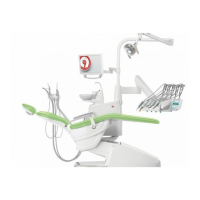
Check that the patient is sitting properly when moving the chair (see figure).


 To Next Page