
 Need help?
Do you have a question about the Apach E Series and is the answer not in the manual?
The manual is essential for oven use, maintenance, and is intended for various personnel roles.
Details information required by the 'CE MARKING' found on the oven's back label.
Covers essential safety measures, operator profiles, and definitions of hazardous areas.
Outlines customer responsibilities for safety, training, and equipment integrity.
Details safe practices for moving, assembling, and lifting the oven and its parts.
Covers daily checks, safe start-up, and end-of-shift actions for safe oven operation.
Specifies safety measures for maintenance, cleaning, and adjustments, emphasizing powered-off operations.
Mentions that oven components must be disposed of according to applicable laws.
States the oven's acoustic level is below 80 dB(A), usually not requiring hearing protection.
Details the oven's safety features like insulated handles, insulation materials, and electrical protections.
Explains the meaning of danger and mandatory safety signs used within the manual.
Identifies safety signs physically present on the oven, like high temperature and electric current warnings.
Identifies residual risks, including thermal dangers and risks from not using PPE.
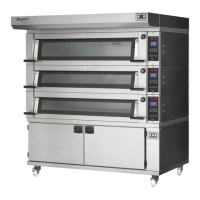
Provides an overview of the modular electric oven and its configurable modules like hoods and provers.
Labels the main components of the oven as seen from the front.
Details the materials used in the oven's construction, such as stainless steel, glass doors, and insulation.
Labels the components of the oven from the side view.
Describes the control panel options and automatic steam generation control.
Explains controls related to steam exhaust and heating elements.
Describes the steam generator's function, placement, and power requirements.
Describes an alternative door option made of stainless steel with insulating material.
Explains the leavening prover's structure, function, and optional steam generator.
Details the structure and optional components of the steam exhaustion hood.
Describes the electromechanical control panel as an alternative to electronic controls for manual oven management.
Refers to chapter 11 for power/water connections and explains steam channeling for waste.
States compliance with CEI EN 60204-1 for wiring and food-contact material regulations.
Presents technical data, dimensions, and power specifications for various oven models.
Defines oven use for baking and prohibits use in explosive atmospheres.
A strong warning against using the oven in environments with explosive potential.
Lists conditions under which the manufacturer is not liable for damages, e.g., improper use.
Provides general precautions for handling and lifting, including equipment capacity and sling inspection.
Details equipment and operator qualifications for handling packed and unpacked ovens.
Covers suitable transport methods and anchorage requirements for packages.
Provides guidelines for storing the oven, whether packed or unpacked, in a dry environment.
Outlines requirements for installation location: exhaust, floor load, and environment.
Specifies minimum clearance requirements for oven positioning for use and maintenance.
Lists acceptable temperature, humidity, and altitude ranges for optimal oven operation.
States that assembling and testing specific parts are the user's responsibility.
Advises checking for transport damage, verifying oven details, and initial cleaning before use.
Refers to the back wall of the chamber for connection points.
Details electrical connection requirements: earth, cut-out box, cable specifications.
Specifies water connection points, pipe sizes, and water quality for steam generators.
Covers steam evacuation requirements, materials, draught, and chimney diameter.
Outlines checks after installation: connections, voltage, and thermostat probe fitting.
Instructions for closing the chamber/door and setting the temperature for the first heating.
Provides a diagram for gradual heating of natural stone soles to prevent cracking.
Emphasizes the need for operator experience and formal training for oven operation.
Provides an overview of machine operation, distinguishing electronic and electromechanical panels.
Lists general rules for safe operation, including following the manual and using PPE.
Explains the buttons and display elements of the standard digital control panel.
Describes setting percentages for floor, front, and ceiling heating elements.
Lists technical data for the control panel, including temperature limits and program types.
Introduces functions controlled by the panel: temperature, time, and programs.
Guides on setting the baking chamber temperature using the control panel.
Explains how to set the power percentage for the oven floor element.
Details how to set the power percentage for the oven's front element.
Guides on setting the power percentage for the oven's ceiling element.
Explains how to set the baking time using the control panel buttons.
Details how to set steam injection duration for models with steam generators.
Describes manual steam activation and how the timer indicates activation time.
Explains power management modes for controlling oven power usage.
Guides on memorizing and setting temperature, time, and steam parameters for programs.
Explains how to start and stop the baking cycle and indicates status on the display.
Details the procedure for setting the oven's date and time via the control panel.
Guides on setting a delayed start time for oven operation on a daily or weekly basis.
Explains how to access and set machine parameters, requiring a password for technicians.
Details user-level parameters that can be customized, such as LCD contrast and date format.
Identifies the display for ceiling temperature and its related controls.
Identifies the display for floor temperature and its related controls.
Guides on setting the floor temperature in the bi-temperature mode.
Guides on setting the ceiling temperature in the bi-temperature mode.
Detailed steps for setting the floor temperature in the baking chamber.
Detailed steps for setting the ceiling temperature in the baking chamber.
Describes the function of the main line switch for powering the panel.
Explains the thermostat for setting the ceiling temperature.
Explains the thermostat for setting the floor temperature.
Describes activating steam generation and the steam generator switch.
Provides an overview of machine operation, distinguishing electronic and electromechanical panels.
Refers to specific instructions for starting the oven without the steam generator.
Details startup for ovens with steam generators, including pre-heating time.
Explains how to control steam discharge from the chamber using a knob.
Shows the control panel for the hood and its components like extractor and condenser.
Describes the prover's control panel for temperature and humidity regulation.
Explains the analog hygro-thermostat for prover temperature and humidity adjustment.
Details prover use with humidifier, including steam control and pilot lights.
Advises on checks during the oven's running-in cycle.
Lists recommended materials and tools for cleaning different oven parts.
Provides a schedule for daily, weekly, and monthly cleaning tasks.
Warns against using aggressive chemicals, solvents, or non-biodegradable products.
States that tampering with safety devices absolves the manufacturer from responsibility.
Specifies monthly checks for electric parts by a qualified technician.
Details replacing light bulbs/door glass and cleaning the steam generator.
Emphasizes that certain repairs must be performed exclusively by authorized personnel.
Steps for replacing the digital control panel of the oven.
Procedure for replacing the thermocouple used with the digital panel.
Steps for replacing parts within the oven's electrical system.
Details on replacing thermostats or switches on the electromechanical control panel.
Instructions for replacing the tempered glass pane of the oven door.
Steps for replacing the baking soles (refractory surfaces) in the oven chamber.
Procedure for removing and replacing the oven's heating element.
How to adjust or replace the spring mechanism that assists the oven door.
Steps to replace a control switch on the prover.
Procedure for replacing the hygro-thermostat inside the prover.
Steps to replace heating elements or the fan within the prover.
Instructions for replacing the optional steam generator unit for the prover.
Monthly lubrication instructions for visible door hinge parts.
Information required when ordering spare parts for the oven.
Lists common problems like panel illumination failure, water leaks, and heating issues.
Instructions for cleaning and emptying pipes for temporary oven storage.
Guidelines for extended storage: cleaning, covering, and environmental considerations.
Outlines purchaser rights regarding repair information and documentation during transfer.
States dismantling must comply with local and EU environmental disposal legislation.
Notes that the oven has no rotating masses, resulting in non-existent acoustic pressure levels.
References the wiring diagram standard.
Details the 12-month guarantee, exclusions, and conditions for warranty claims.

 To Next Page
 General