284 DG14 and DG16 Board & Sensor Reference Manual
XMG: Exception Messages
$PASHS,NME,XMG,x,c,[f]
This command enables or disables the exception messages or port x, where x is
the output port, c is ON or OFF, and f is the optional message output rate ranging
from 0.05 to 999 seconds depending on the measurement update rate option
installed.
The DG16 does not output this message unless it computes a position.
If the command is set without a period, the DG16 uses the period set by the
$PASHS,NME,PER command If the $PASHS,NME,PER command is issued after
this message period has been set, the period resets to the PER setting.
Example
Enter the following command to enable XMG message on port B.
$PASHS,NME,XMG,B,ON
$PASHQ,XMG,[c1]
This command queries the exception messages, where c1 is the optional port
designator for the output of the response. If a port is not specified, the receiver
sends the response to the current port.
$PASHR,XMG, d1,d2
The response is in the format
$PASHR,XMG, d1,d2 where d1 is the exception
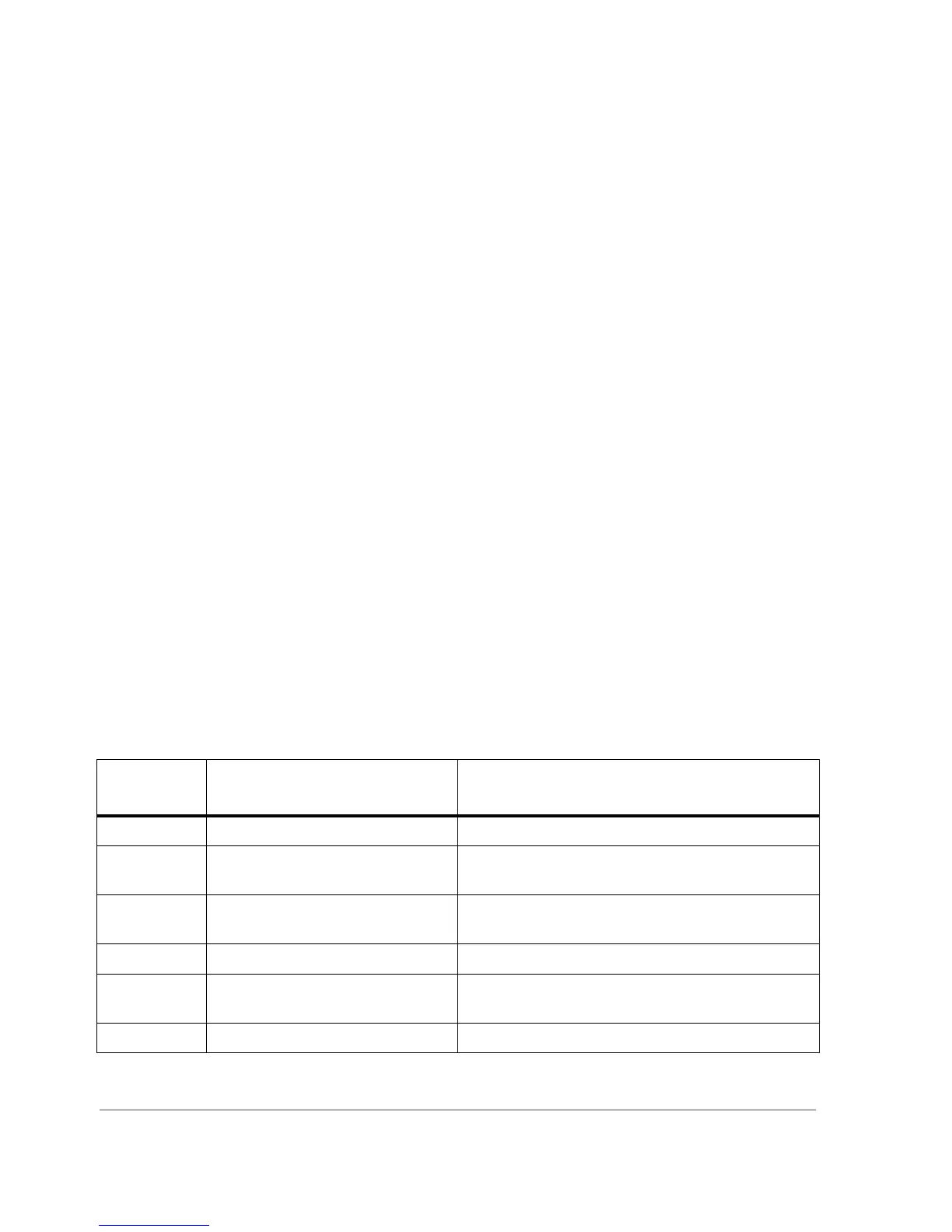
number and d2 is a description of the exception message. Table 8.57 describes
the exception numbers.
Table 8.57. $PASHR,XMG Exception Number Descriptions
Exception
Number (d1)
Description Meaning
01 SRAM corrupted The DG16 enters Set Defaults state due to lost data.
02 Real Time Clock Corrupted The DG16 initiates a cold start due to loss of time
information.
03 No Position or Almanac The DG16 initiates a cold start due to lack of position
or almanac data.
04 BIT completed End of built-in-test routines.
05 Cannot converge with 4 or more
satellites
No navigation solution in auto mode with 4 satellites.
06 Cannot converge with 3 satellites No navigation solution in auto mode with 3 satellites.



 To Next Page