6. Device installation and start-up
User Manual – PhysioGo.Lite Electro page 24 / 96
6. Device installation and start-up
Unit installation
The first installation should be performed by a qualified manufacturer's or distributor's representative!
After removing the unit from the carton, check if the complete unit has been delivered. In case of any
inconsistencies contact the distributor or manufacturer.
After removing the unit from transportation packaging, depending on conditions during transport, wait
approximately two hours before proceeding to next installation steps. This is aimed at adaptation of the unit
to conditions in operation room.
The unit shall be placed on a table, trolley or in a cabinet near mains socket with power input 100-240V and
frequency 50/60 Hz. It is recommended to place the unit at such a height that it would enable convenient
operation from the front panel.
The light shall enable easy readout of display indicators, however the unit shall not be exposed to direct sunlight.
6.1.1 Connection of patient’s cables and application of electrodes
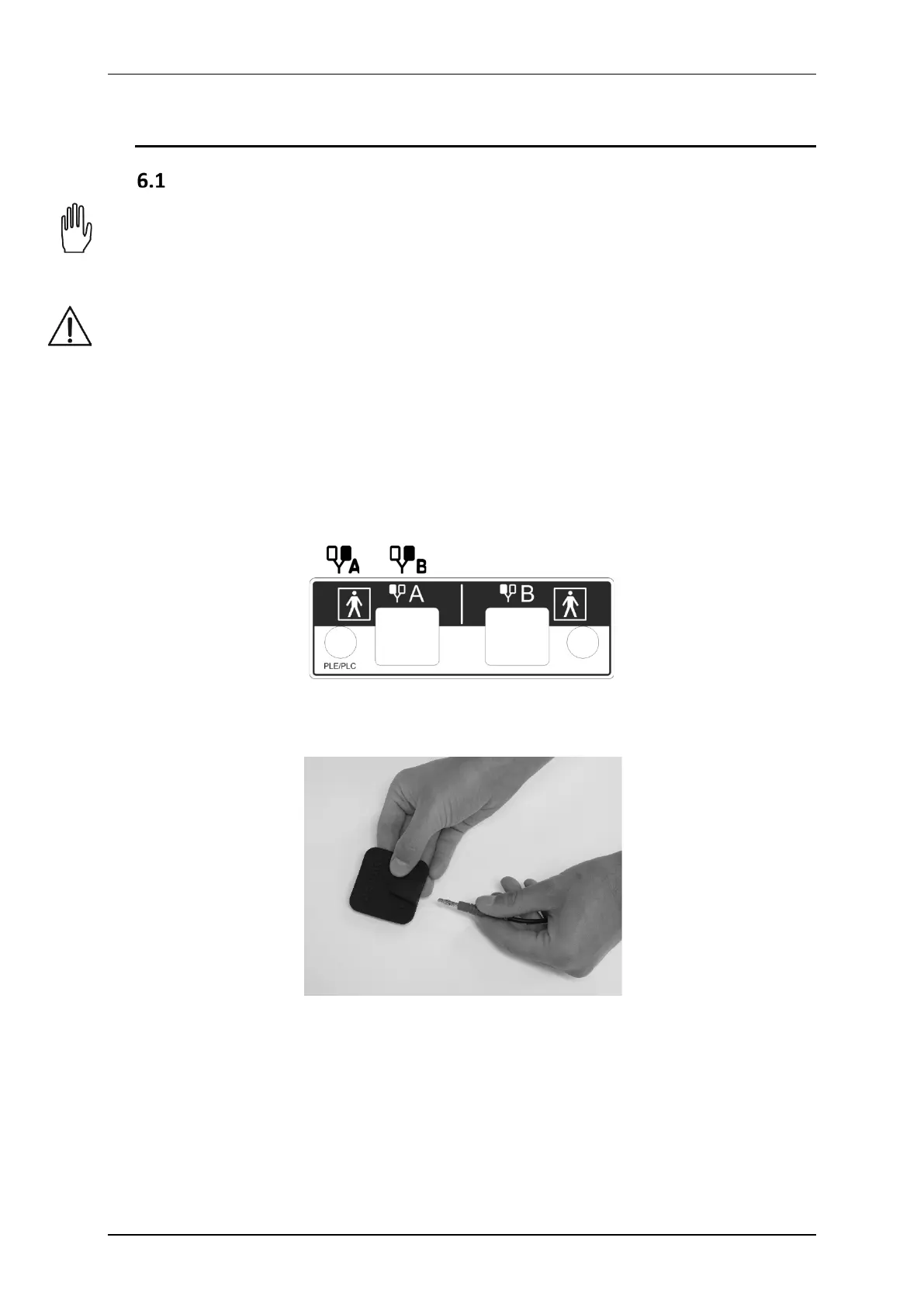
Electrotherapy cables should be connected to electrotherapy socket according to Figure 6.1. Electrotherapy
sockets are marked with symbols: and .
Figure 6.1 Electrotherapy sockets label
Patient cables are terminated with banana type 4 mm or 2 mm plugs – two are red and the other two are black.
Channels are marked with appropriate symbols. Electrodes should be connected to those plugs.
Figure 6.2. Connection of electrodes
After switching the unit on, red plugs are connected to positive pole, and black plugs are connected to negative
pole. Electrode connection polarity matters in case of treatments with galvanic currents as well as unipolar
currents of low and medium frequency.
As a standard accessory, the unit is equipped with elastomer-carbon electrodes. Parameters of such electrodes
facilitate performing treatment procedures within a full range of available values of output signals amplitudes. It
is recommended to operate with the unipolar currents using metal – tin or aluminum electrodes, as they wear
out much slower than the electrodes made from other materials.



 To Next Page