8. Definitions and parameters
page 45 / 96 Issue date 18.05.2021, rev. 1.0
Treatment timer
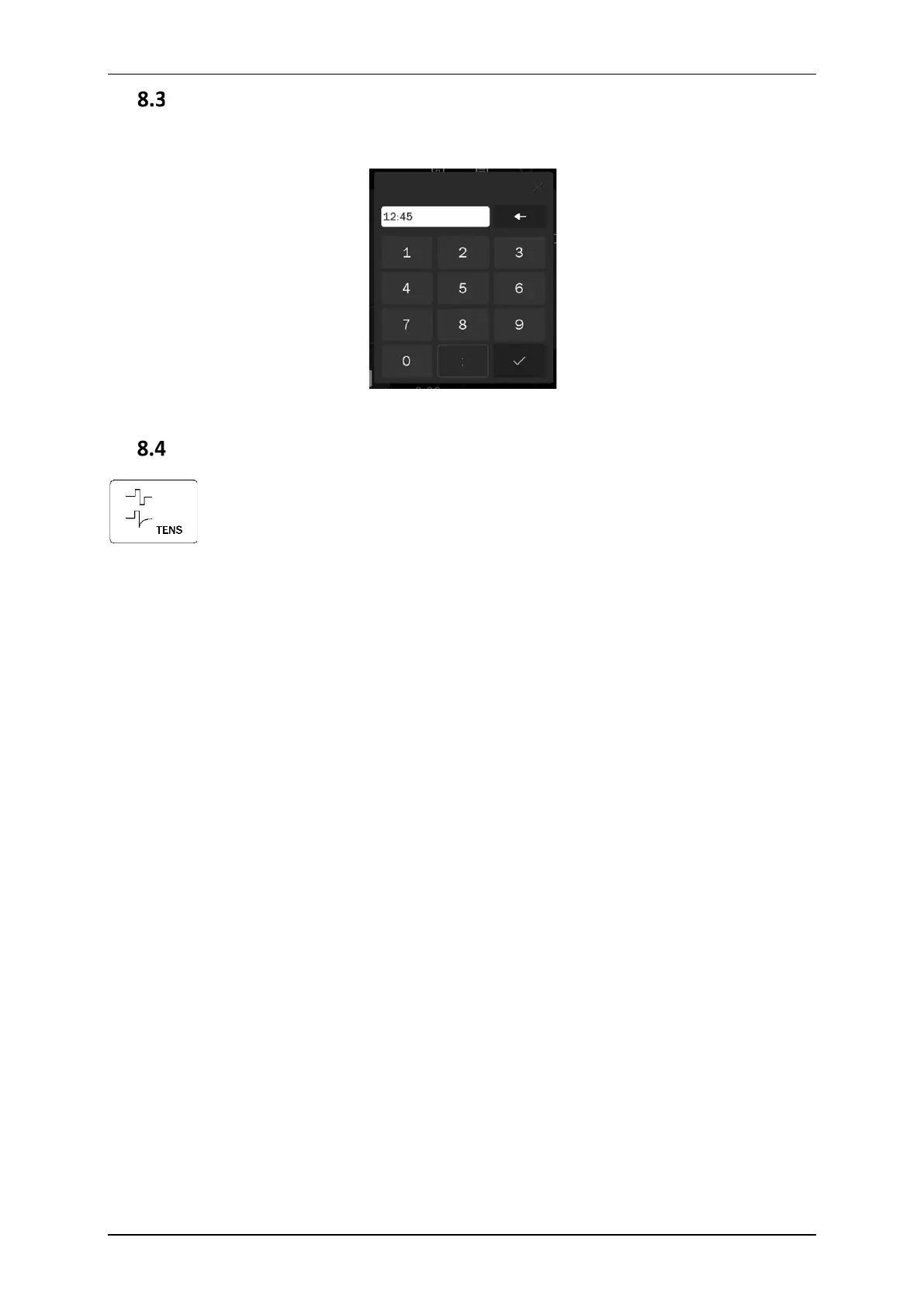
The treatment time is adjustable from 1 - 60 minutes with a step of 1 minute. It is also possible to adjust manually
by "holding" the field with time by means of a pen / finger – in increments of 1 s (Figure 8.2)
Figure 8.1. Manual time setting
TENS pulse current
The TENS method (Transcutaneous Electrical Nerve Stimulation) was developed in the 1960s as an alternative to
the then modern analgesic stimulation conducted with electrodes implanted adjacent to posterior horns of spinal
cord. According to the check gate theory of Wall and Melzack, stimulation of fast-conducting nerve fibers of the
A type inhibits the conductivity of slow-conducting fibers of the C type, responsible for connection of pain
receptors with posterior horns of spinal cord. The check gate constitutes here the common synaptic system,
loaded with the burden of A type fiber pulses, which inhibits pain transmission. Additional phenomenon
accompanying the TENS stimulation is increase in endorphin production in Central Nervous System centers. TENS
are used mainly for prolonged analgesic therapy and for stimulation of skeleton muscles.
The pulse current used with this method consists of rectangular bipolar pulses, symmetrical, asymmetrical
or asymmetrical with alternately changing polarization. The choice of pulse shape is at the discretion of the
patient’s preferences. Symmetric and asymmetric pulses have similar biophysical properties. The pulse duration
is short, whereas the amplitude is relatively high. The pulse frequency occurs within the range from several to
more than one hundred Hertz. The TENS pulse current is frequency and amplitude modulated, which aims at
delay in adaptation and creation of relax phases during session.
The BURST 7/2 program consist of 7 pulse sequences (timp = 100 µs) generated every 10 ms, occurring
with 2 Hz frequency.
The BURST 7/4 program consist of 7 pulse sequences (timp = 100 µs) generated every 10 ms, occurring
with 4 Hz frequency.
The BURST 9/2 program consist of 9 pulse sequences (timp = 100 µs) generated every 10 ms, occurring
with 2 Hz frequency.
The BURST 9/4 program consist of 9 pulse sequences (timp = 100 µs) generated every 10 ms, occurring
with 4 Hz frequency.


 To Next Page