8. Definitions and parameters
User Manual – PhysioGo.Lite Electro page 68 / 96
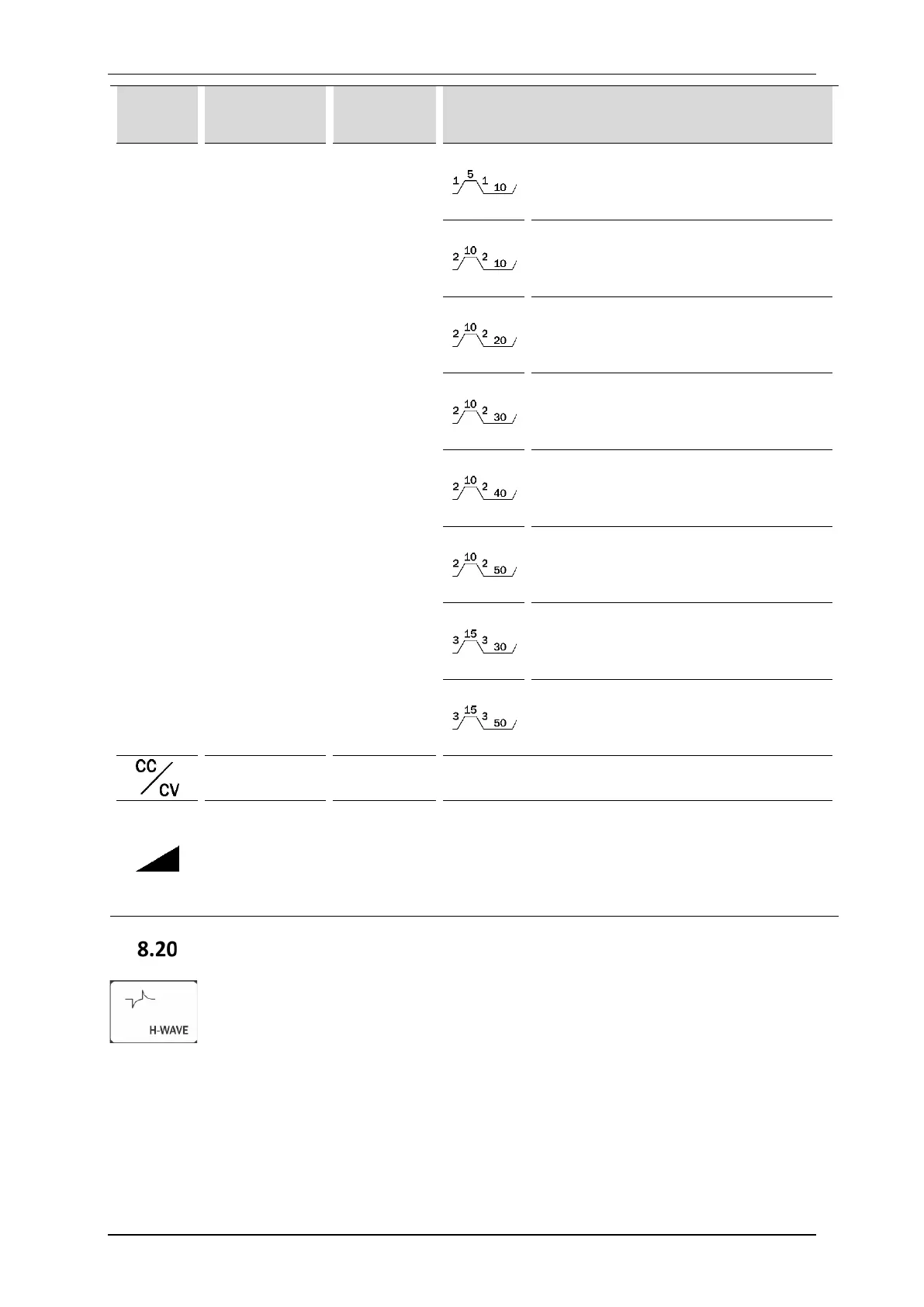
Symbol Description
treatment
Available parameters
Contraction phase 5 s
Fall time 1 s
Contraction phase 10 s
Fall time 2 s
Contraction phase 10 s
Fall time 2 s
Contraction phase 10 s
Fall time 2 s
Contraction phase 10 s
Fall time 2 s
Contraction phase 10 s
Fall time 2 s
Contraction phase 15 s
Fall time 3 s
Contraction phase 15 s
Fall time 3 s
Amplifier
operation mode
-
CC – stabilized output current
CV – stabilized output voltage
Maximum
amplitude
-
Regulation step:
• 0,5 mA in the range of 1-140 mA
2 – 140 V in CV mode, max. 140 mA
Regulation step:
•
0,5 V in the range of 2-140 V
H-waves
H-waves are rectangular, bidirectional current with a constant pulse duration that uses a low frequency (level of
2 Hz) to stimulate the muscles and a higher frequency (level of 60 Hz) to effectively relieve pain.
Low frequency increases the lymph and blood flow, accelerates toxin outflow and reduces swelling. In the higher
frequency mode, the H-waves work by their influence on the sodium pump function within the nerve and thus
produce a profound anaesthetic / analgesic effect.



 To Next Page