8. Definitions and parameters
page 47 / 96 Issue date 18.05.2021, rev. 1.0
Symbol Description
treatment
Available parameters
Maximum
amplitude
-
Regulation step:
• 0,5 mA in the range of 1-140 mA
2 – 140 V in CV mode, max. 140 mA
Regulation step:
• 0,5 V in the range of 2-140 V
Interferential currents
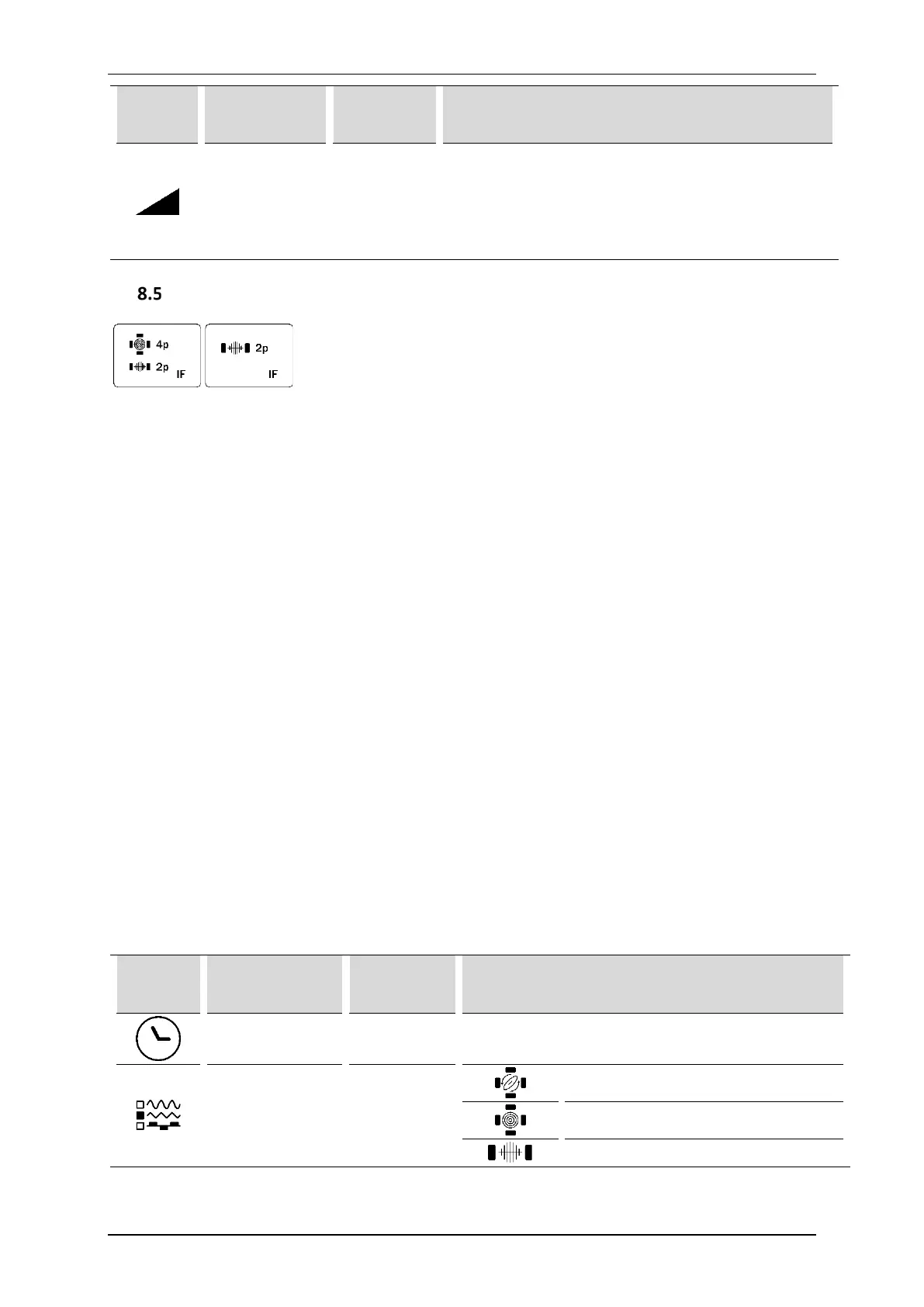
Interferential current is a two-channel sine wave current with carrier frequency with modulated amplitude to
the basic frequency. Most frequently basic frequency is modulated, i.e. it changes with the time within the preset
spectrum. In modern electrotherapy devices, the carrier frequency can be from 2 to 10 kHz.
As opposed to the classic technique of generating interferential currents within patient’s tissue (frequency
interference), the internal modulation process has been transferred to the inside of the unit. This technology
causes generation of interference field occupying much space (the therapeutic current passes larger tissue space
than with the classic method), interference occurs even in case of not very precise electrode application, which
simplifies the treatment method.
In case of dynamic interferential current additional amplitude and phase modulation of both channels was
introduced, which causes the area of most effective therapeutic current operation to sweep in cycles the area
between the electrodes (vector scanning). This effect increases additionally the volume capacity exposed
to stimulation and continuous change of interference field location delays the adaptation process.
Isoplanar interferential current – its properties are similar to the current resulting from the classical
interference, generated by the older unit versions. The unit has the additional amplitude modulation causing
that the treatment covers the entire area between the electrodes and not just a small part on bisector of angles
formed by lines connecting the electrodes centers from both circuits. This simplifies the placement of electrodes
and improves the spatiality of the current therapeutic effect.
Bipolar interference current is applied with two electrodes (one channel). Its biophysical properties are the same
as in the case of standard interference, however, it features somewhat lesser penetration range. It is
recommended for electrotherapy applied onto a small area or in places, which are not easily accessible. Because
of the similarity to the interferential current it is determined as the IF-2P on the list of treatment programs.
Static interferential current – is not directly available. In order to apply this current you should choose AMF
current working in A+B mode and use both channels while placing the electrodes.
Parameters description:
Symbol Description
treatment
Available parameters
Treatment time - 1 – 60 minutes, 1 minute step
Shape of the
current
-
Diadynamic interferential current
Isoplanar interferential current
One-channel AMF current


 To Next Page