8. Definitions and parameters
page 49 / 96 Issue date 18.05.2021, rev. 1.0
The bipolar pulse current of such duty cycle is subjected to amplitude modulation to obtain smooth increase and
reduction of output current within patient circuit (by the use of a training program), which results in mild muscle
contraction and relaxation effect with determined activity and rest phase. The training program is selected
depending on the purpose of therapy and the patient's needs. Kotz describes stimulations using frequency within
the above range, suggesting that by using the 2500 Hz frequency the deeper located muscle layers are excited.
The stimulation methodic is similar to the classic method utilizing unipolar rectangular or triangular impulses.
Most frequently the bipolar method is used by applying small, flat electrodes above extreme segments of muscle
belly. Stimulation involves the parts of muscle groups that perform the same movement.
The Kotz’ stimulation influences correctly innervated skeletal muscles. The method is useful for stimulation
of hypotrophic muscles disappearing due to immobilization and for exercise of healthy muscles. It can also be
used to treat tissue injuries to achieve an analgesic or hyperemic effect. This method does not enable stimulation
of partially and totally denervated muscles. It is worth remarking here that the method is practically painless.
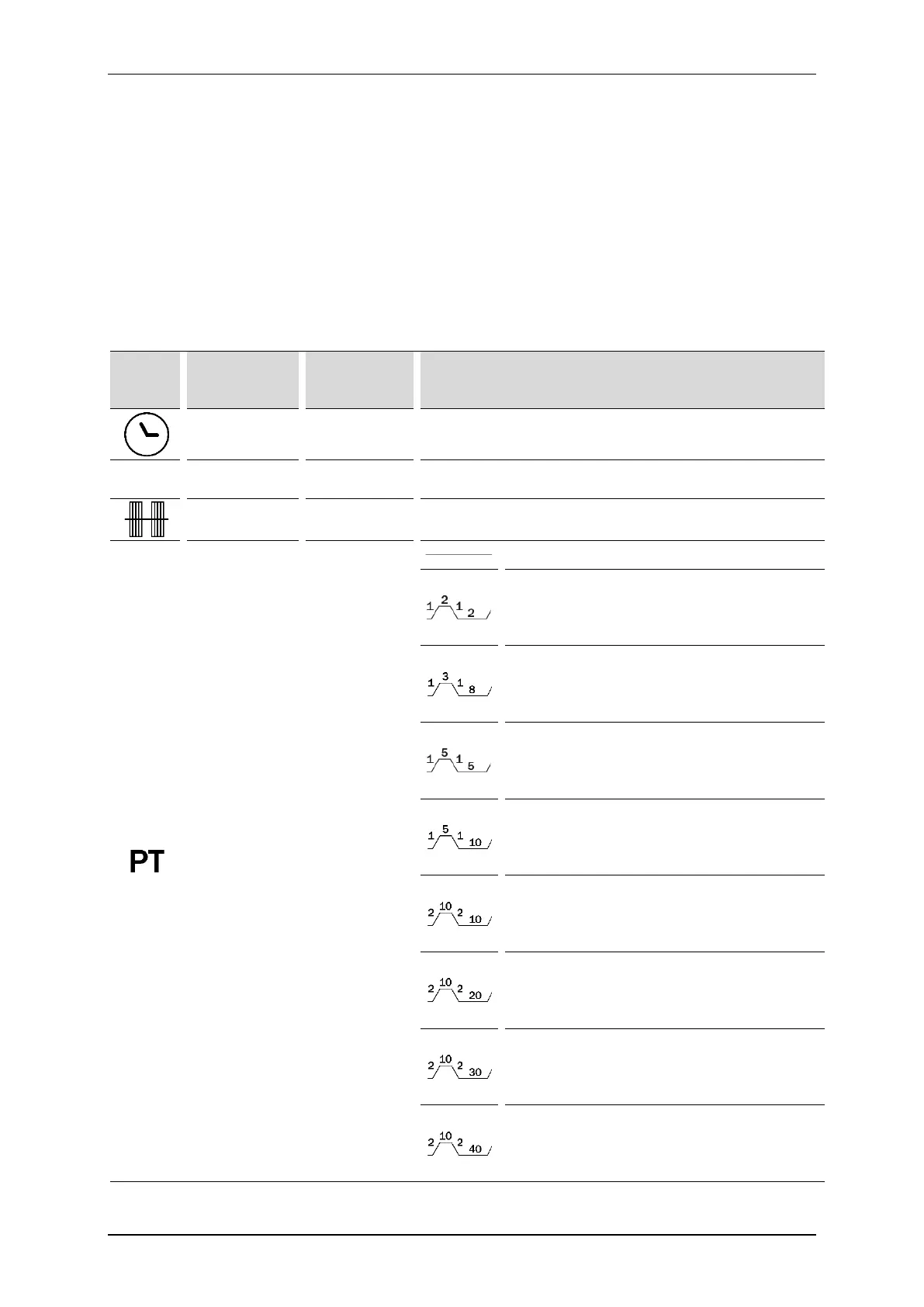
Parameters description:
Symbol Description
treatment
Available parameters
Treatment time - 1 – 60 minutes, 1 minute step
-
- 2500 Hz – default parameter
Basic frequency f_bas Regulation in the range of 3 Hz – 100 Hz (variable step)
Training
program
PT
No training program
Contraction phase 2 s
Fall time 1 s
Contraction phase 3 s
Fall time 1 s
Contraction phase 5 s
Fall time 1 s
Contraction phase 5 s
Fall time 1 s
Contraction phase 10 s
Fall time 2 s
Contraction phase 10 s
Fall time 2 s
Contraction phase 10 s
Fall time 2 s
Contraction phase 10 s
Fall time 2 s



 To Next Page