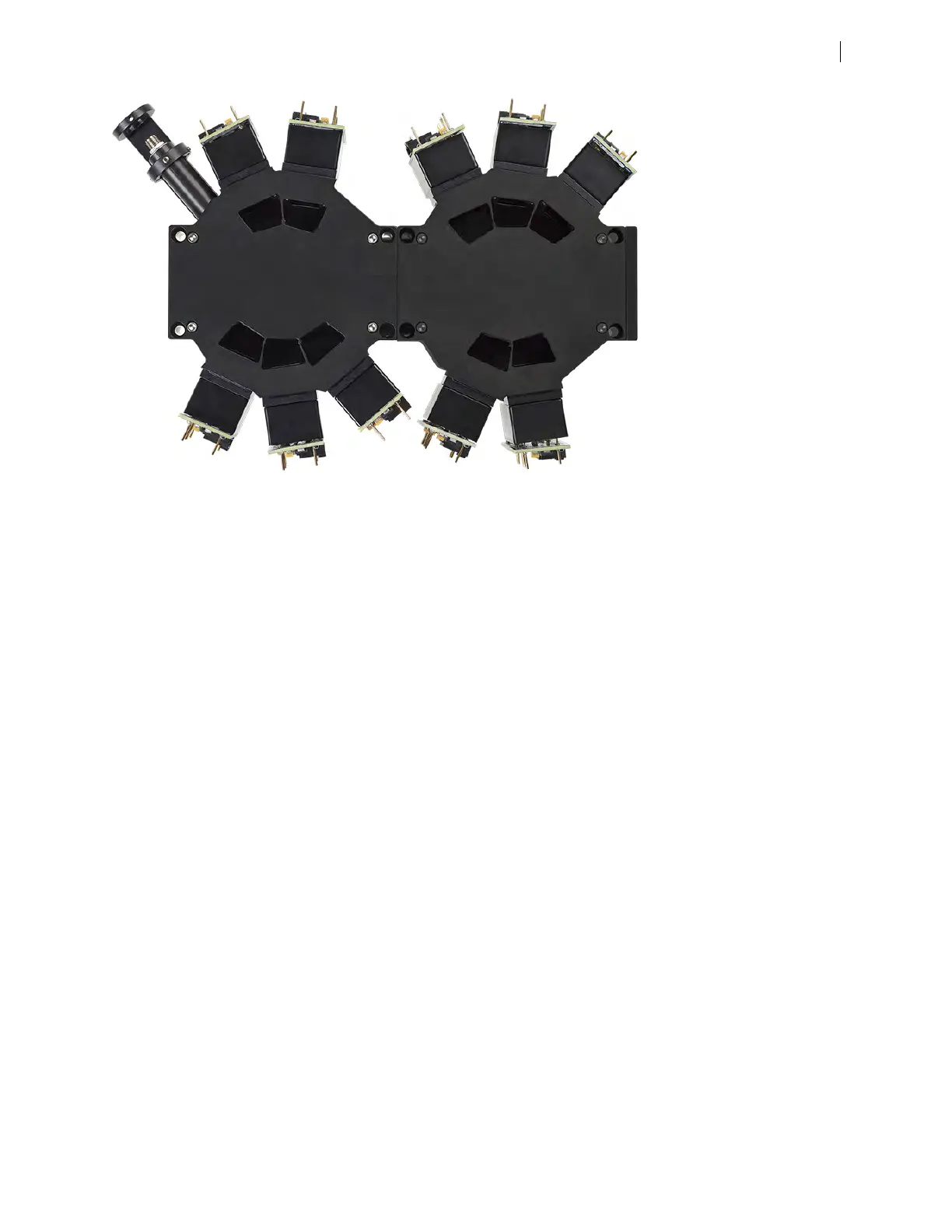
Signal detectors
Particles in the fluid stream passing through the laser beam absorb energy are excited to emit photons at
discrete lower frequencies. When these photons reach a detector, electrical pulses are created that are then
processed by the electronics system.
There are two types of signal detectors in the BDFACSymphony™A5SE flow cytometer:
l
PMTs Used to detect the weaker signals generated by side scatter (SSC) and all fluorescence channels. These
signals are amplified by applying a voltage to the PMTs.
l
Photodiodes. Less sensitive to light signals than the PMTs. A photodiode is used to detect the stronger
forward scatter (FSC) signal.
Laser/Detector/Mirror/Filter Combinations
Each PMT has an optic holder in front of it. The optic holders are labeled with numbers indicating the
wavelengths of the bandpass filter and longpass dichroic mirror they contain (for example, 780/60 and 750 LP,
respectively). The optic holder in front of the last PMT in the detector array contains only a bandpass filter and
is marked accordingly.
Base configurations
Each flow cytometer has a base cytometer configuration that corresponds to the layout of the installed lasers
and optics in your cytometer. This base configuration is factory set.
Cytometer configuration in BDFACSDiva™
BDFACSDiva™ software provides a base configuration for your flow cytometer. In the case of the
BDFACSymphony™A5SE flow cytometer, the base configuration corresponds to the fixed configuration for the
spectral function. For details, see Spectral functions (page 47). Select Cytometer >View Configuration to
Chapter 2 Introduction 21






 To Next Page