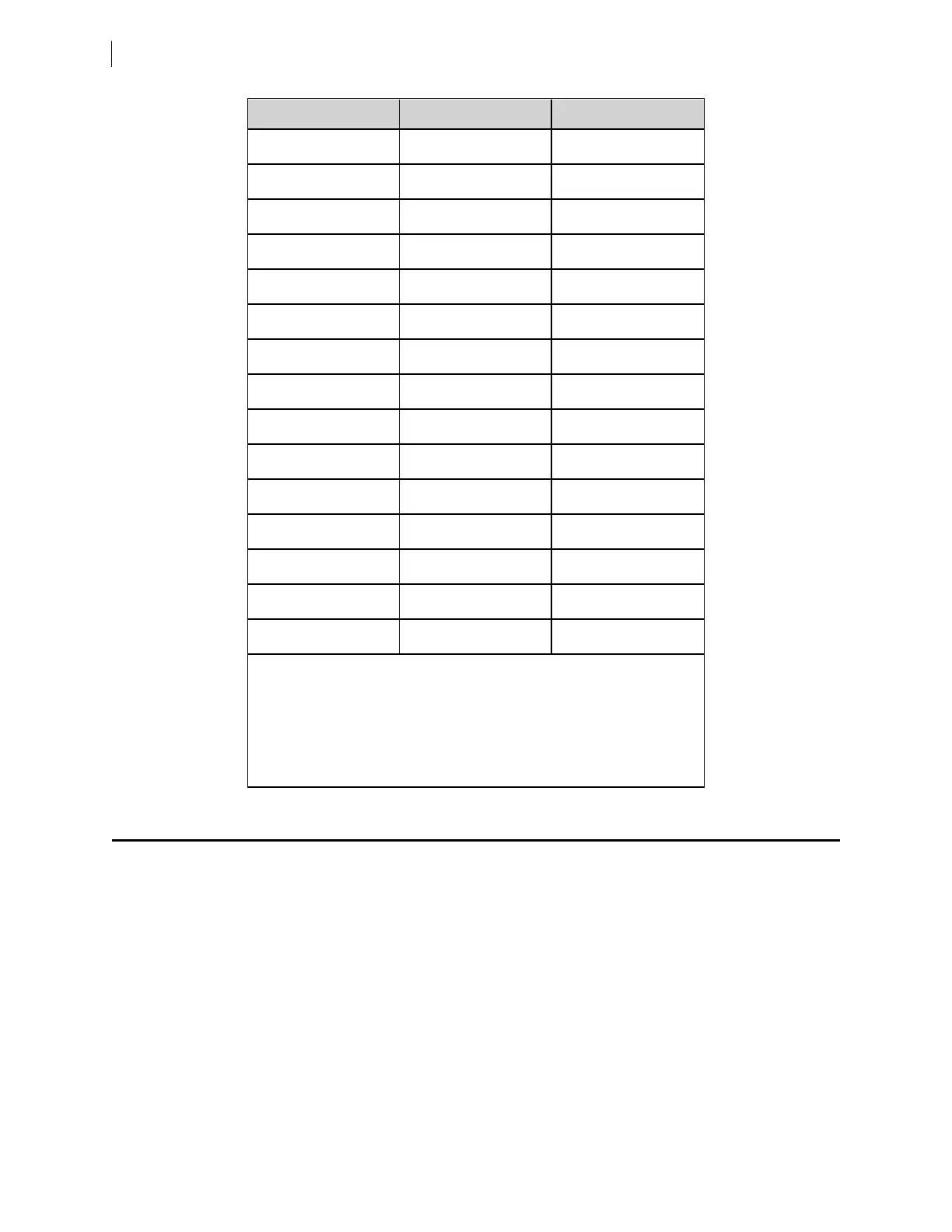
Dye Primary Channel Secondary Channel
PE-Cy5 B675 YG660
PE-Cy5.5 YG750 YG730
PE-Cy7 YG825 YG780
PE-Vio
®
770 YG825 YG780
PerCP B675 V680
PerCP-Cy5.5 B675 V710
RY586
d
YG602 YG585
R718
e
R730 R710
SparkBlue™ 550 B537 B602
Spark NIR™ 685 R680 R730
Super Bright 600 V615 V660
V500
e
V510 V540
VioBlue
®
V450 V470
VioGreen™ V540 V510
Unstained UV446 UV515
a
Available from BD as members of the BDHorizon Brilliant™ Blue family of dyes.
b
Available from BD as members of the BDHorizon Brilliant™ Ultraviolet family of
dyes.
c
Available from BD as members of the BDHorizon Brilliant™ Violet family of dyes.
d
Available from BDas a member of the BDHorizonRealYellow™ family of dyes.
e
Available from BDas members of the BDHorizon™ family of dyes.
Autofluorescence
Autofluorescence is the intrinsic fluorescent signal produced by a cell when stimulated by lasers. It is present to
some extent on all particles, and varies from cell type to cell type (for example, monocytes have a different
autofluorescence spectrum than lymphocytes). Spectral unmixing can be used to extract the autofluorescence
spectrum of the cells of interest in your experiment and to separate this intrinsic fluorescent signal from the
signal emitted by the fluorochromes in your experiment.
The autofluorescence control is the "single-stained"control for the autofluorescence in the experiment. In a
spectral experiment, autofluorescence is unmixed as if it were another fluorochrome in your experiment. The
autofluorescence control must use the same cell type as your fully stained sample. The other single-stained
controls are not constrained in this way. For example, beads could be used for the other single-stained controls,
but not for the autofluorescence control.
To add an autofluorescence control, see Setting up a new spectral experiment (page 57).
54 BD FACSymphony™ A5 SE User's Guide



 To Next Page