Safety Information
T3300 Diagnostic Ultrasound System | 15 | B00601-010 4/10/17
mobile RF Communications Equipment and the system as recommended below, according to the
maximum output power of the communications equipment.
For transmitters rated at a maximum output power not listed above, the recommended separation
distance D in meters (m) can be estimated using the equation applicable to the frequency of the
transmitter, where P is the maximum output power rate of the transmitter in watts (W) according to
the transmitter manufacturer.
NOTES
• At 80 MHz and 800 MHz, the separation distance for the higher frequency range applies.
• These guidelines may not apply in all situations. Electromagnetic propagation is affected by
absorption and reflection from structures, objects and people.
WARNING
Operation of the equipment below that value may cause inaccurate results.
2.2.4 Surges to AC Power Mains
If the system is powered from AC mains that could experience surges above 1 kV (for example, from
extreme lightning conditions), additional surge suppression is recommended.
2.3 Mechanical Safety
Observe the following precautions when using the system for mechanical safety.
WARNINGS
• When attempting to overcome an obstacle, do not push the system from either side with
excessive force, which could cause the system to tip over.
• When positioning the system, move it carefully to avoid pinching hands or extremities
against other objects, such as a bed rail.
• Do not roll the system over transducer cables or power cords.
2.4 Equipment Protection
Observe the following precautions to protect your system.
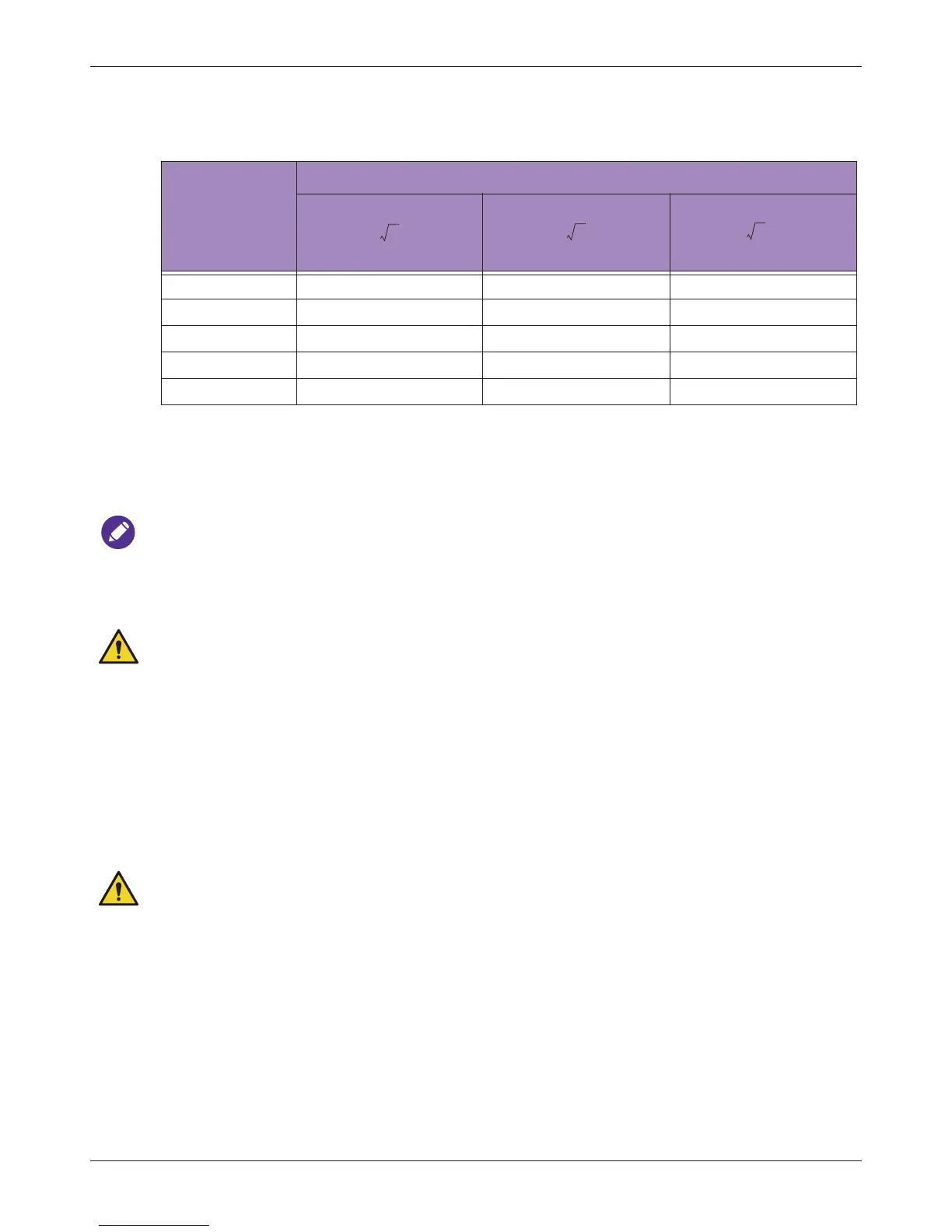
Table 7 Separation distances
Maximum
Output Power
of Transmitter
Watts (W)
Separation Distance According to Frequency of Transmitter Meters (m)
150 kHz to 80 MHz
80 MHz to 800 MHz
800 MHz to 2.5 GHz
0.01 0.12 m 0.12 m 0.24 m
0.1 0.37 m 0.37 m 0.74 m
1 1.17 m 1.17 m 2.34 m
10 3.69 m 3.69 m 7.38 m
100 11.67 m 11.67 m 23.34 m


 To Next Page